
If you own a single-family rental in Sisters, you’re sitting on one of the tightest small markets in Central Oregon right now. The Sisters rental market April 2026 is defined by exceptional occupancy, steady year-over-year rent growth, and a quiet but real divergence between the for-sale market (which is softening) and the rental market (which is not). That divergence is the story.
Here’s the headline: SFH occupancy in Sisters is sitting at roughly 96.7%, in-place SFH rents are averaging around $2,410 per month, and year-over-year asking rents are up about 5.7%. Listed asking rents pulled back month-over-month, but with only a handful of active listings driving that average, the noise drowns out the signal. The actual paid rent on existing leases is the truer read.
This update breaks down what changed from March, where the data points to opportunity, where it points to caution, and what the new affordable housing supply pipeline forming in town means for landlords over the next 12 to 18 months. Let’s dig in.

What Changed From March to April: The Snapshot
Month-over-month visibility is what makes a monthly update useful, so let’s start there.
SFH in-place rent (Sisters): Approximately $2,410 in April. This is the average rent actually being collected across roughly 146 occupied SFH units in our tracked sample, and it’s the most reliable read on what landlords are actually earning.
SFH asking rent (Zillow, Sisters): $2,800 in April, down from $3,000 in March. On paper, that’s a 6.7% month-over-month decline. In reality, it’s a five-listing average. With that small a sample, one luxury home rolling off the market or one mid-tier home rolling on can swing the number 5% or more. Treat this as directional, not definitive.
SFH vacancy rate (Sisters): Approximately 3.3% based on five active Zillow listings against an estimated 151 tracked SFH rental units in town. That’s exceptional, and meaningfully tighter than the broader Deschutes County reading.
SFH days on market (Sisters): Approximately 78 days on properties that recently leased. That’s roughly half the Deschutes County SFR average of 154 days, but it’s also a reminder that Sisters is a small market where each listing takes time to find the right tenant.
Year-over-year SFH rent growth: Approximately +5.7%, climbing from $2,650 in April 2025 to $2,800 in April 2026.
The story underneath those numbers is straightforward. The rental market is tight, demand is real, and the seasonal lull between ski season and summer tourism is showing up in asking rents but not in occupancy. For broader context, our Bend Rental Market March 2026 Update covers what’s happening 20 minutes southeast, and our Sisters Rental Market Q1 2026 Update sets the baseline this report builds from.
SFH Average Rent in Sisters: In-Place vs. Asking
The most important number in this report is also the most overlooked: in-place rent, or what tenants are actually paying right now on signed leases.
Across our tracked Sisters SFH sample, the average in-place SFH rent in April is roughly $2,410 per month. That’s what’s actually being collected by landlords who own and operate single-family rentals in Sisters proper.
Compare that to the $2,800 average asking rent showing up on Zillow’s five active SFH listings. The $390 gap is real, but most of it is composition, not market shift. The handful of SFH rentals on Zillow at any given moment skew toward higher-end or recently turned-over homes, while existing tenants in older leases or smaller homes are paying meaningfully less.
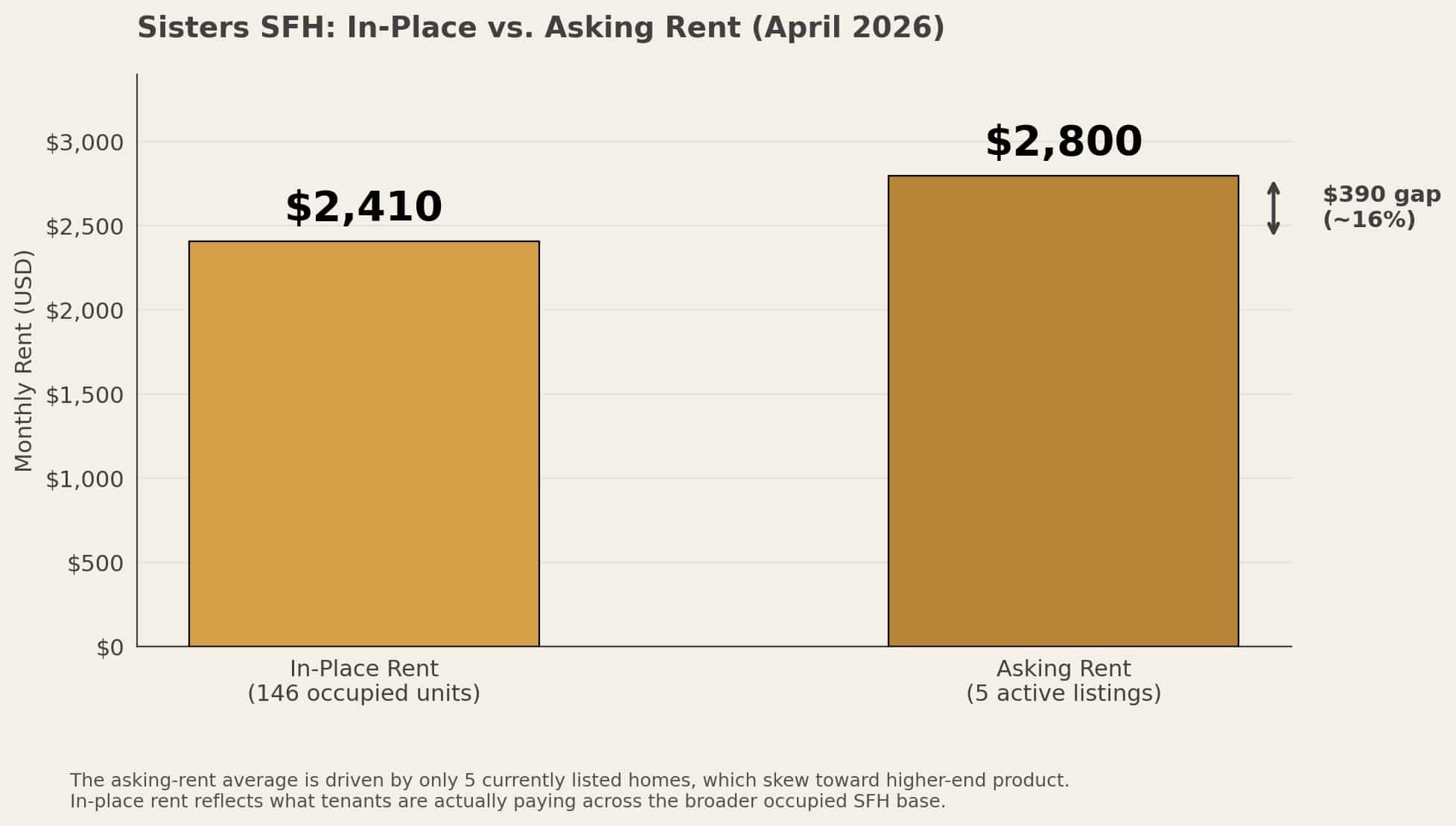
If you’re underwriting an acquisition based on Zillow’s $2,800 asking-rent signal, you’re probably overshooting reality by 10% to 15%. Use $2,400 to $2,500 as your baseline for an existing-tenant scenario, and reserve the $2,800 number for what you might achieve on a turnover with strong marketing and pricing discipline. That gap also tells us something about pricing power: landlords with good tenants paying mid-$2,000s are usually better off renewing at modest increases than chasing the top of the market and risking a 78-day vacancy. We covered this math in our vacancy reduction strategies guide, and for broader regional comps, our Average Rent in Bend Oregon 2026 analysis and Apartment List’s Bend rent report are useful references.
SFH Vacancy Rate: 3.3% and Holding
Vacancy is the metric most owners obsess over, and for good reason. A single empty month wipes out roughly 8.3% of annual rent. In Sisters, the SFH vacancy picture is unusually clean.
Using active listings on Zillow against an estimated total Sisters SFH rental stock of approximately 151 homes, the April 2026 SFH vacancy rate sits at roughly 3.3%. That puts Sisters at the low end of what’s considered a healthy SFR market. National benchmarks from sources like the National Apartment Association generally consider 3% to 7% vacancy a healthy range. Sisters is at the floor.
The investor takeaway: don’t model 3.3% as your structural vacancy. Use 6% to 8% to account for the realistic possibility of a 60- to 90-day turnover when it does occur. The current tightness is a tailwind, not a guarantee. For statewide context, PAROA publishes Oregon vacancy commentary worth tracking.
Days on Market: 78 Days, and Why It’s Both a Strength and a Caveat
When we look at the SFH properties that recently leased in Sisters, the average days on market clocks in at roughly 78 days. At first glance, that looks slow. In context, it’s actually fast.
Compared to the Deschutes County SFR average of about 154 days, Sisters SFH leases roughly 50% faster than the broader county. It’s slower than Bend proper (per our Bend Rental Market March 2026 Update) but nearly identical to Sisters MFH at 74 days. Bend has dramatically more renter demand, while Sisters has fewer renters and fewer listings, so the math comes out reasonably close.

The caveat: 78 days means landlords should be prepared to carry roughly two-and-a-half months of vacancy when turnover does occur. With 96.7% occupancy, turnover is rare, but when it happens, it’s expensive.
The practical implications are straightforward. Price right from day one (listings priced 5% above market in Sisters tend to sit, and once they sit, prospective tenants assume something is wrong). Time your turnover by structuring leases to expire in the May-through-August window when seasonal demand peaks, not in the November-through-February shoulder. And invest in retention, because a renewal at a modest increase beats a 78-day vacancy at a higher rent essentially every time.
SFH Rent Growth: +5.7% Year-Over-Year, but Read the MoM Number Carefully
Year-over-year, SFH asking rents in Sisters are up roughly 5.7%, climbing from approximately $2,650 in April 2025 to $2,800 in April 2026. That’s healthy, real-dollar appreciation that beats inflation and tracks above many other Oregon markets.
Month-over-month, the picture is messier. Asking rents pulled back from $3,000 in March to $2,800 in April, a 6.7% decline. Three things to know. First, the sample size is tiny: five active Zillow listings drove the April average, and one luxury home rolling off the market is enough to swing it several percentage points. This is a composition shift, not a market decline. Second, in-place rents tell a different story. In-place SFH rents at roughly $2,410 are stable, because existing landlords don’t have vacancies to fill. Third, the seasonal pattern is normal: April is a shoulder month between ski and summer tourism, and mild softness in asking rents is what we’d expect.
Bottom line: the annual trend is up, the monthly trend is noisy, and you don’t make portfolio decisions on a single month of asking-rent data, especially in a market this small.
Average Tenancy Length: A Genuinely Long-Hold Market
Here’s where Sisters quietly differentiates itself from most rental markets in Oregon. We don’t have clean SFH-specific tenancy data, but using multifamily as the closest proxy, the MFH retention rate runs roughly 66.5%, implying an average tenancy length of approximately 36 months. National averages typically sit between 12 and 18 months. Sisters is roughly double that.
Several factors drive the long-hold dynamic. Sisters’ median age sits around 50, and roughly 37% of residents are retirees per Data USA. With ~151 SFH rentals in town total, a happy tenant doesn’t have a long list of comparable options. And people who choose Sisters tend to choose it intentionally, drawn by the school district, trail systems, and small-town character.
For SFH landlords, this is a critical insight. The combination of 96.7% occupancy plus ~3-year average tenancies means the tenant you sign today is probably the tenant you’ll have in 2029. That changes how you should think about screening, pricing, and property condition. The cost of a bad tenant compounds over years; the benefit of a great tenant compounds even more, which is why we emphasize rigorous screening on every Sisters placement we manage at Legacy Property Management.
Multifamily Context: Important, but Secondary to the SFH Story
Most Sisters investors are focused on single-family, and that’s correct. SFH is the dominant rental product in town and where the rent premium concentrates. But the multifamily side is doing something this April worth understanding.
A year ago, Sisters MFH vacancy was sitting at a brutal 35.6%, crisis-level oversupply. Today, MFH vacancy is roughly 5.1%, a 30-point improvement in 12 months. The apartment oversupply that defined Sisters in 2024 and early 2025 has been substantially absorbed.
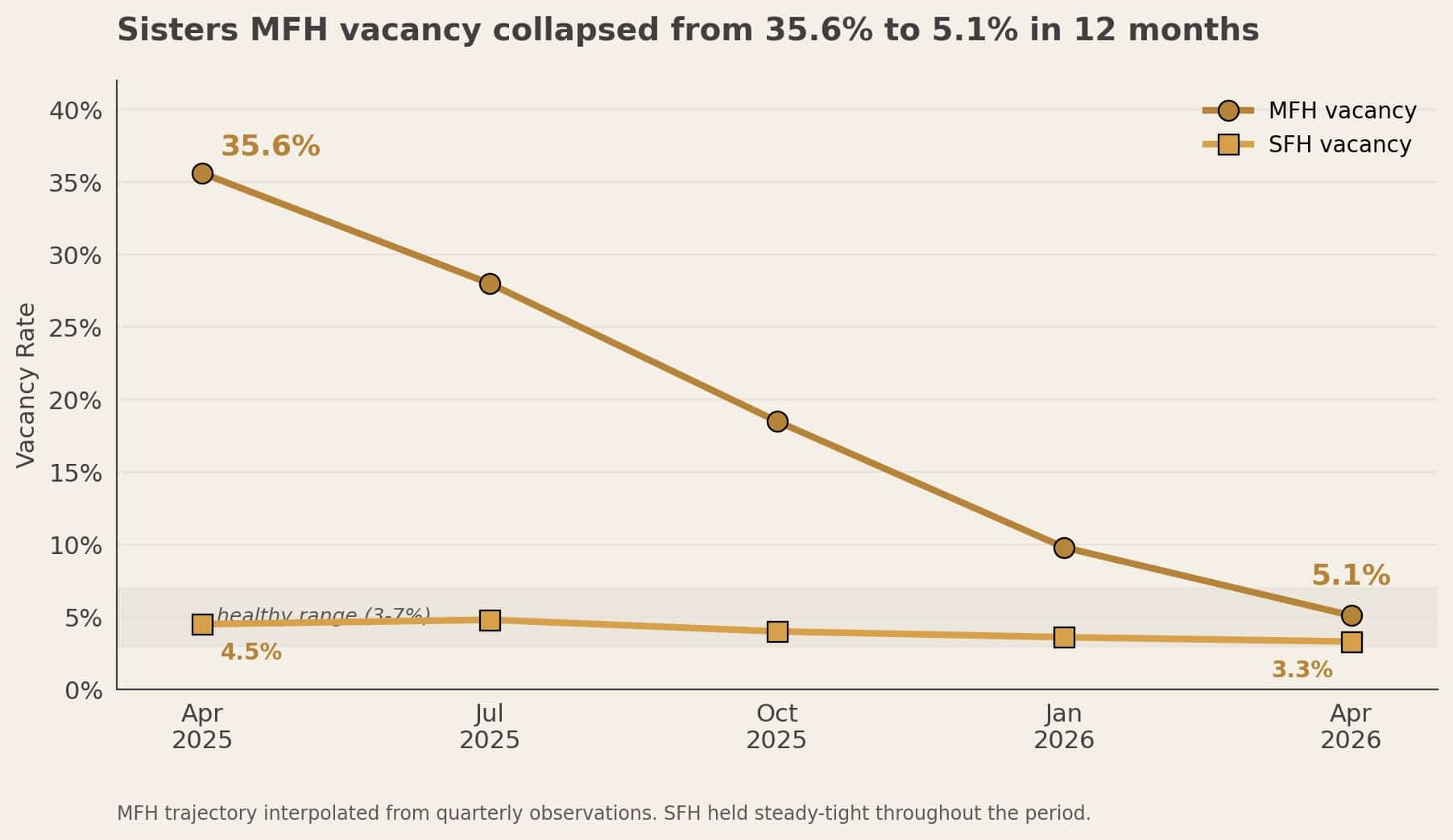
For SFH landlords, three implications: less downward pressure from MFH alternatives now that apartments are no longer discounting heavily; the SFH-to-MFH rent premium is real and durable (Sisters in-place SFH at ~$2,410 is roughly $617 above MFH at ~$1,793, a 34% premium); and the new supply pipeline forming in town is mostly multifamily and townhome product, which is unlikely to compress SFH rents materially. For broader regional rent comps, our Average Rent in Bend Oregon 2026 analysis walks through the Central Oregon comp set in detail.
Bonus Key Metric: The Sale-vs-Rental Divergence
Here’s the metric driving April’s narrative in Sisters: the for-sale and rental markets have decoupled.
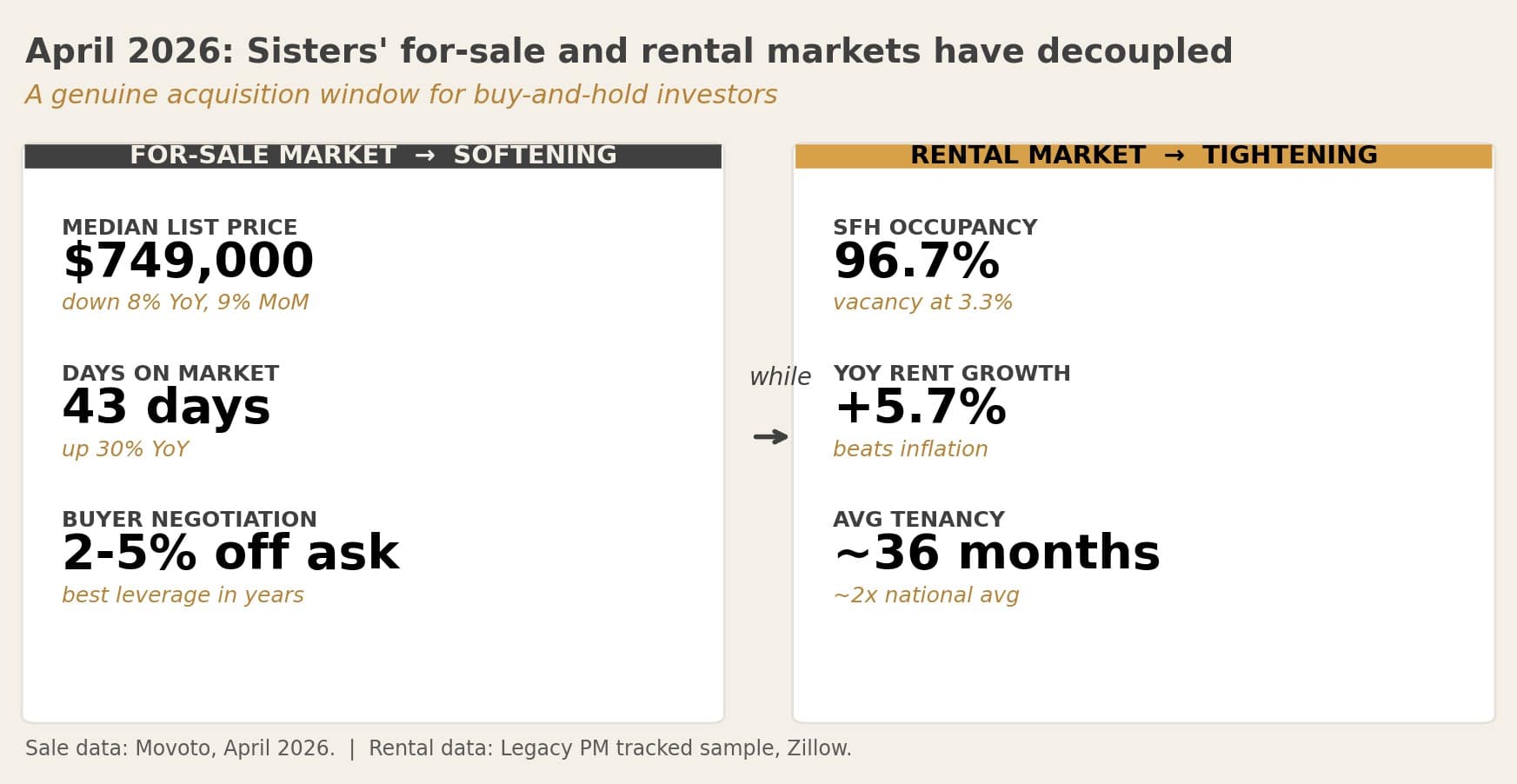
The for-sale side is softening. Per current April 2026 listings data, the median list price in Sisters is approximately $749,000, down 8% year-over-year and 9% month-over-month, with median days on market for sale listings stretched to roughly 43 days. Local agents are reporting buyers negotiating 2% to 5% off asking, which is genuine leverage that hasn’t existed in this market for nearly a decade. Movoto’s April 2026 Sisters market data corroborates the same trend.
Meanwhile, the rental market is doing the opposite. Occupancy is at 96.7%, tenants are renewing, and YoY rents are up nearly 6%.
What does this divergence mean? Sisters is currently one of the more attractive acquisition windows for buy-and-hold investors that Central Oregon has offered in years. You can negotiate purchase price 2% to 5% below ask, take time to inspect carefully without a competing-offer panic, and feel confident that rental fundamentals support strong long-term cash flow. Per-square-foot pricing in Sisters runs 15% to 20% below comparable Westside Bend product.
The caveat: this window typically closes by mid-summer when seasonal buyer demand returns. April and May are likely the best leverage you’ll see this year. If timing acquisitions to capture both the price negotiation on the buy and the strong rental fundamentals on the back end is a conversation you’d like to have, reach out.
What’s Coming: The Sisters Workforce Housing Pipeline
April 2026 is also the moment Sisters’ affordable and workforce housing pipeline visibly stepped forward. Three projects matter.
Trinity Place broke ground in March 2026, a 40-unit rental apartment development at 1, 2, and 3 bedrooms targeting households at 50% to 80% of area median income. It’s being developed by Northwest Housing Alternatives in partnership with the City of Sisters. Leasing is expected in spring 2027.
Larch Commons is a 26-home cottage development from Sisters Habitat for Humanity, with vertical construction beginning summer 2026. It’s a for-sale rather than for-rent project, but it pulls demand off the rental market by giving qualified buyers a path to ownership.
Sisters Woodlands is a 35-acre mixed-use development west of downtown, offering cottages, townhomes, and condos with fire-resilient construction standards.
For current SFH landlords, near-term impact (next 12 months) is essentially zero. Nothing delivers before spring 2027, and even then the rental component is small relative to existing demand. In 2027 and beyond, expect modest competition for entry-level renter demand at the bottom of the market. SFH product priced above $2,400 monthly is well insulated; bargain-tier product (sub-$1,800) will see more direct competition. For deeper local development coverage, The Nugget Newspaper and KTVZ are the two best sources.
What This All Means for Investors and Landlords
Pulling it together, here’s how I’d read the Sisters SFH rental market April 2026.
If you already own SFH rental in Sisters, this is a market to play defense on. Renew good tenants at modest, sub-cap increases (5% to 8%, well below the 9.5% Oregon statewide cap). Don’t push aggressively on existing leases and risk a 78-day vacancy. Use the ~3-year average tenancy as your planning horizon and prioritize property quality investments that protect retention.
If you’re considering acquiring SFH rental in Sisters, the April-May window is unusually favorable. Underwrite to $2,400 to $2,500 in-place rent (not $2,800 asking), model 6% to 8% structural vacancy (not the current 3.3%), and budget for fire-resilience improvements that increasingly affect insurability.
If you’re a real estate agent working with investor clients, Sisters is worth a conversation right now. Our 10 Things Every Agent Should Tell Investor Buyers About the Bend Rental Market covers the broader investor-buyer dynamics.
A few principles hold across all three audiences. In-place rent is the truer signal; underwrite to what tenants actually pay, not asking-rent noise. Vacancy looks great until it doesn’t, so plan for the 78-day re-leasing reality. Tenant quality compounds in a long-hold market, where Sisters’ 3-year average tenancy means a great placement pays dividends for years. And don’t overweight the monthly noise: annual and quarterly trends carry more signal than month-over-month wiggles in a market this small.
Those fundamentals always win, regardless of what the headline numbers say in any given month.
Navigating the Sisters rental market April 2026 takes specialized local knowledge, real-time pricing discipline, and a long-term mindset that matches the long-hold nature of the market itself. At Legacy Property Management, we partner with single-family rental owners across Sisters, Bend, and Redmond to position properties competitively, screen tenants rigorously, and protect long-term cash flow. Our Sisters property management page walks through how we do it, and you can reach out today if you’d like a current rent estimate or a portfolio review.


Sisters Rental Market: September 2026
October 14, 2026 Sisters Rental Market: September 2026 Home Sisters Oregon Rental Market Report · September 2026 Monthly market report from Legacy Property Management The

Redmond Rental Market: September 2026
October 14, 2026 Redmond Rental Market: September 2026 Home Redmond Oregon Rental Market Report · September 2026 Monthly market report from Legacy Property Management The

Bend Rental Market: September 2026
October 14, 2026 Bend Rental Market: September 2026 Home Bend Oregon Rental Market Report · September 2026 Monthly market report from Legacy Property Management The
OUR DIRECT CONTACT INFO
