
Bend Oregon Rental Market Report · September 2026
Monthly market report from Legacy Property Management
The Bottom Line: Bend rental market September 2026, in one sentence: rents came off their summer peak right on schedule. The average house asked $3,100 a month, down $100 from August and up $100 from a year ago. Underneath the price, supply is building: 243 houses were listed in early October, the most we have tracked, and they have been on the market an average of 52 days. For small landlords, this is the month to lock in good tenants, price any vacancy to today's market rather than August's, and send renewal notices early. Mortgage rates just hit 7.4%, which keeps more would-be buyers renting and gives well-run rentals a steady floor through winter.

Bend Rental Market September 2026: Rent Eases to $3,100
In our August Bend rental market report, we called $3,200 the seasonal high and said rents typically ease from there into winter. September confirmed it. The average asking rent for a house in Bend was $3,100, down $100 (3.1%) from August's $3,200 and up $100 (3.3%) from September 2025, when Bend sat at $3,000.
Look at the shape of the year and the pattern is clear. Rents climbed from about $2,950 in the first quarter to $3,100 in April, touched $3,200 in June, dipped in July, matched $3,200 again in August, and are now stepping down. That double top is a seasonal ceiling, not a breakout. Last year followed the same script a few months earlier: a spring peak, a $100 give-back, and then a long, flat stretch at $3,000.
If you check Zillow this week, you will see an even lower number: $2,995, down $105 for the month and essentially flat (down $5) from a year ago. That figure is Zillow's early October snapshot, not September, so we report it as a preview. It tells us something important, though. The year-over-year gain Bend carried all summer has nearly disappeared heading into fall.

Rent Growth: The Real Number Is About 3%
Monthly asking rents in Bend bounce around more than the underlying market does. This year, year-over-year growth on the average house listing has swung between 0% and nearly 7% from one month to the next, mostly because the mix of homes listed changes. A few dozen large houses at $4,000 or more arriving or leasing can move the average by $100 on their own.
To see past that noise, we check Zillow's Observed Rent Index for single-family homes across the Bend metro, which tracks rent changes on comparable homes rather than whatever happens to be listed. That steadier measure shows single-family rent growth peaked at 5.6% in June and has cooled to 3.1% as of August. Adjusted for the normal seasonal pattern, single-family rents have been flat since June.
Our read: Bend house rents are still growing, but at roughly 3% a year, not the 6% to 7% the summer headlines suggested. That is a healthy, inflation-plus pace. It is not a market that rewards aggressive pricing this fall.

Days on Market and Listings: Supply Is Building Into Fall
This is where September's story really lives. As of October 5, there were 243 houses for rent in Bend, up 11 from the 232 we counted on September 1 and the highest count since we began tracking listing snapshots in late June. Current listings have been on the market an average of 52 days, up from 48 days a month ago and 44 days in early August.
On their own, those moves look modest. Multiply them together and you get what we call inventory-days, a simple measure of how much unleased marketing time is sitting in the market. It rose 13.5% in a single month to 12,636, the biggest jump we have recorded. In plain terms: more houses are listed, and they are sitting longer. That combination is what pushes landlords toward price cuts as the weather turns.
One caution. We do not yet have a clean read on where these numbers stood last October, so we cannot say how much of this is normal fall seasonality. What we can say is that supply kept growing through September instead of clearing.

How Many Bend Houses Are Sitting Empty?
Bend has roughly 7,500 detached houses occupied by renters, based on U.S. Census survey data. With 243 listed, about 3.2% of Bend's single-family rental stock was on the market in early October, up slightly from 3.1% in September and 2.3% at the end of June.
We call this listed availability rather than a vacancy rate, and the distinction matters. Some listed houses are still occupied by a tenant who has given notice, and some vacant homes never get listed. What makes the number useful is its direction. A reading that creeps from 2.3% to 3.2% over a single summer tells you the market has loosened, and that it has not tightened back up as leasing season ended.
Where Houses Are Priced, and Who Can Afford Them
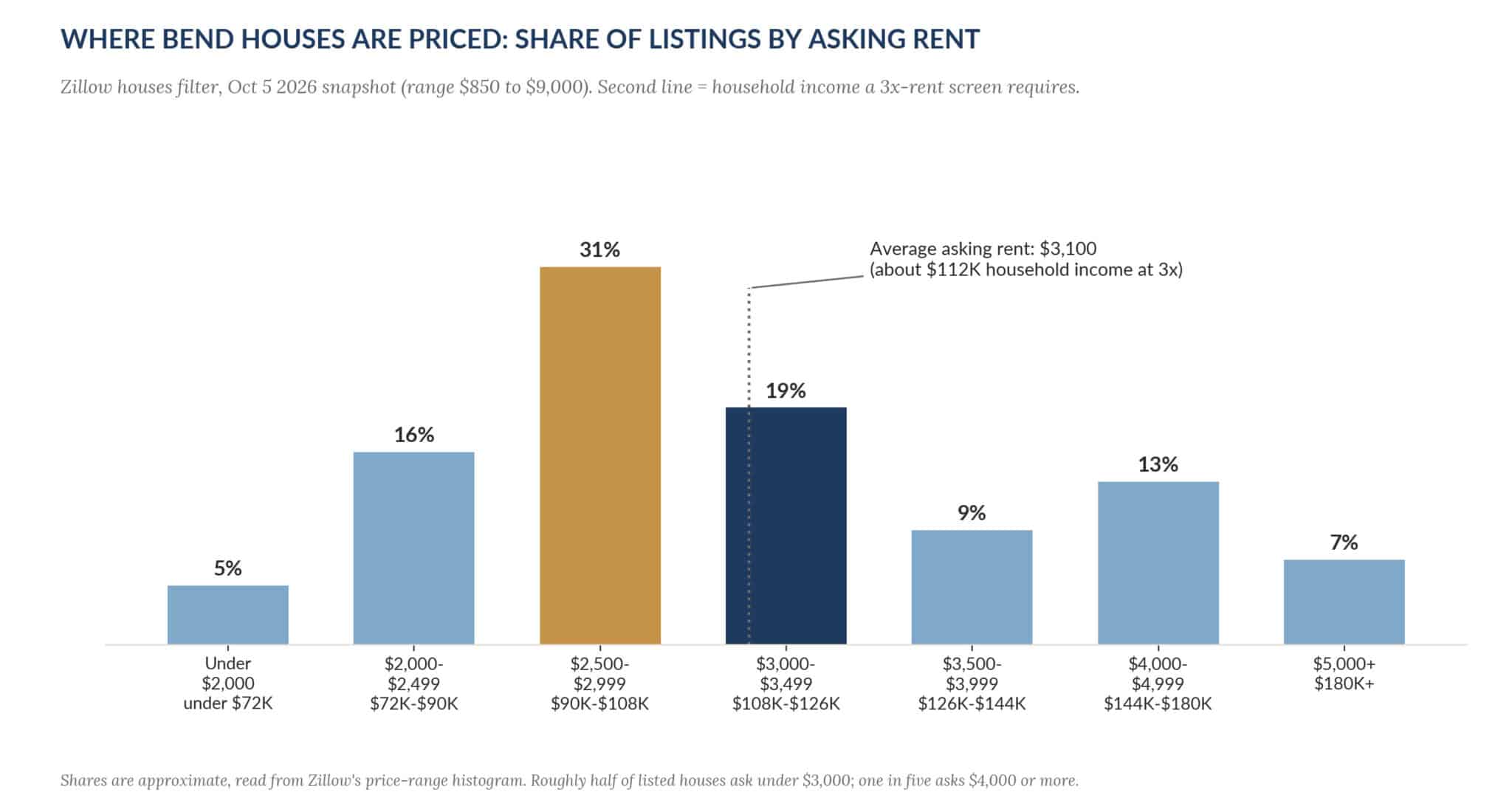
Bend's listed houses range from $850 to $9,000 a month, but the market lives in a much narrower band. Roughly half of listed houses ask under $3,000, with the biggest cluster right around $2,900. About one in five asks $4,000 or more, and those higher-end homes do most of the work pushing the average up.
Affordability is the ceiling on all of this. A $3,100 house requires about $112,000 in household income under a standard three-times-rent screen. The typical Bend renter household earns about $80,000, according to the latest Census survey. That means the pool of tenants who can comfortably qualify for an average house is a fraction of all renters, and it is the same pool every landlord is competing for this fall.
The gap between asking rents and what tenants actually pay matters here too. Across roughly 4,700 Bend house leases we track, the average rent tenants were paying in early September was about $2,812 a month, essentially unchanged from August's $2,804. That is roughly $290 (about 9%) below today's $3,100 average asking rent, which is one more reason a good tenant on a renewal is worth more than a new one at a slightly higher number.
Tenancy Length: About Three Years, and Worth Protecting
How long do Bend tenants stay? The latest Census survey offers a useful window. Among Bend's roughly 19,000 renter households, about a third had moved in within the prior two years, while nearly four in ten had been in their home since before 2020. That puts the typical Bend renter household at about three years in place.
Single-family tenants tend to stay longer than apartment renters. Families settle into school zones, and moving a household out of a house is a bigger project than leaving a one-bedroom. Our working estimate for Bend house tenancies is three to four years.
That matters more than usual right now. At 52 days on market, a single turnover on an average house costs more than $5,000 in lost rent before cleaning, paint, repairs, and leasing costs. A modest renewal increase that keeps a reliable tenant in place almost always beats a bigger number on a vacant house in November.
Apartments: Steady Rents, a Shrinking Pipeline
Bend's large apartment communities averaged $1,935 a month as of October 1, according to Yardi Matrix data published by RentCafe, up 3.7% from a year ago and up about $16 since August. A three-bedroom apartment averages about $2,323. That leaves the average house roughly $1,165 (about 60%) above the average apartment, and about $777 above a three-bedroom unit. Apartments are the main fallback for tenants who decide a house is out of reach, and occupancy across Bend's apartment market has been running in the low-to-mid 90s this year as new buildings lease up.
The bigger story is what comes next. Across Deschutes County, 1,600 single-family homes were permitted over the twelve months through August, up 17% from a year earlier, but most of those are for-sale homes rather than rentals, and the growth is happening largely outside Bend. Within the Bend area itself, new single-family permits fell to 484 over the same twelve months, 13% fewer than a year earlier, according to local MLS-area figures in the Beacon Report. Apartment permitting has nearly stalled. From March through August 2026, the county permitted only 201 multifamily units, compared with 995 over the same months in 2025. Monthly apartment permits are lumpy, and a single large project could change this picture quickly, but six straight slow months is a real signal.
The apartments approved in 2025 are still being built and will keep delivering through 2027, which will hold the lower end of the market in check for a while. After that, the pipeline thins out considerably. For long-term single-family investors, a lighter wave of new apartments in 2028 and beyond is one of the more encouraging signals in this report.

Bonus Metric: Mortgage Rates Just Hit 7.4%
The number driving this month's story is not a rent figure. The average 30-year fixed mortgage rate climbed to 7.40% on October 8, according to Freddie Mac's weekly survey. That is up from 6.43% in early July and the highest level since late 2023. Rates have now risen for seven straight weeks.
Here is what that means in Bend. The median single-family home in Bend sold for $728,000 in September, up 1% from August and 2% from a year earlier, according to local MLS data compiled in the Beacon Report. With 20% down, and counting principal, interest, an estimated 0.9% property tax, and $1,500 a year in insurance, owning that home now runs about $4,703 a month, compared with about $4,325 at early July's rates. Renting the average house costs $3,100. The monthly gap between buying and renting has grown by about 30% since summer, from about $1,225 to about $1,603.
For landlords, this cuts two ways. First, higher rates keep more households renting longer, which supports demand for well-kept houses and supports longer tenancies. Second, homeowners who cannot sell at the price they want are more likely to rent their homes out instead, and some of September's new listings likely came from exactly that group. Bend's for-sale market held about 3 months of supply in September with 492 single-family homes listed, closed sales fell 14% from a year earlier to 155, and roughly 44% of listings have recently taken a price cut, so expect that "accidental landlord" supply to keep trickling into the rental market this winter.

Rules of the Road: Oregon's 2027 Rent Cap Is 10%
On September 28, the state set the maximum allowable rent increase for 2027 at 10%, up from 9.5% in 2026, as KTVZ reported. On a $3,100 house, that allows up to $310 a month. The cap is a ceiling, not a target, and with Bend house rents growing about 3% a year, few renewals should come anywhere close to it. Homes whose first certificate of occupancy is less than 15 years old remain exempt from the percentage cap, though the 90-day written notice rule still applies.
Locally, Bend's proposed rental registry and registration fee are still being drafted. The fee amount, timeline, and any exemptions have not been set, and early estimates suggest a system like this could take two to five years to stand up. We will keep watching and report back as details emerge.
The Local Economy: Steady, Not Surging
Deschutes County unemployment was 4.5% in August, down from 4.8% a year earlier and below Oregon's 5.1%. Within Bend itself, unemployment was 4.2%, and the number of employed residents grew about 0.6% from a year ago. Payroll job growth across the metro, however, was essentially flat at 0.1%. Bend's population is still growing about 1.5% a year, according to Portland State University estimates.
Put together, Bend keeps adding households faster than it adds jobs and wages. That keeps demand for rental housing steady, but it also caps how far rents can stretch before tenants hit their limit.
Bend Rental Market Q3 2026 in Review
September closes out the third quarter, so here is the quarter at a glance. Bend house rents averaged about $3,132 across July, August, and September, up 4.4% from the third quarter of 2025, when rents held at $3,000 all summer. Compared with the second quarter, rents were flat. In other words, Bend's rent gains this year happened in the spring, and the summer held them rather than adding to them.
Supply is where the quarter really moved. From late June to early October, the number of houses listed rose from 175 to 243, and inventory-days climbed 22%. Average days on market shortened from 59 to 52 over the same stretch, but only because a July wave of new listings reset the clock; since early August, days on market have been climbing again. Mortgage rates rose about 0.85 points during the quarter, home prices held flat against a year ago while sales slipped about 4%, unemployment edged down, and apartment permitting stayed close to a standstill.
| Metric | Q3 2026 | Change |
|---|---|---|
| Average asking rent, houses | $3,132 quarter average (Jul $3,095, Aug $3,200, Sep $3,100) | +4.4% vs Q3 2025; flat vs Q2 2026 |
| Houses listed | 175 (Jun 29) to 243 (Oct 5) | +68 houses (+39%) |
| Average days on market, current listings | 59 to 52 days | -7 days |
| Inventory-days | 10,325 to 12,636 | +22% |
| Listed availability | 2.3% to 3.2% | +0.9 points |
| 30-year mortgage rate | 6.43% (Jul 2) to 7.28% (Oct 1) | +0.85 points |
| Deschutes County unemployment | 4.7% (June) to 4.5% (August) | -0.2 points |
| Multifamily units permitted, July and August | 101 units | vs 554 in July and August 2025 |
| Median single-family sale price (MLS) | $743,000 average of monthly medians (Jul $780K, Aug $721K, Sep $728K) | Flat vs Q3 2025 ($744,000) |
| Single-family homes sold | 502 | -3.6% vs Q3 2025 (521) |
| New single-family permits, Bend area, July and August | 65 | vs 73 in July and August 2025 |
Why This Matters for Small Investors and Landlords
September is when Bend's rental market shifts from a landlord's season to a tenant's season, and this year the shift arrived with more supply than usual. Rents are easing from a $3,200 peak, more houses are listed than at any point we have tracked, and those houses are sitting longer. At the same time, nothing in the data points to a weak market. Rents are still up about 3% from a year ago, unemployment is low, the apartment pipeline is thinning, and a 7.4% mortgage rate is keeping would-be buyers in rentals.
The same pattern is playing out across Central Oregon. Redmond's average asking rent slipped to $2,398 and Sisters' rose to $2,700 in September, but in all three markets the like-for-like rent signal is flat to modestly up, and the real movement is in supply and time on market. Bend is the one market where total marketed supply kept growing into fall, yet Bend houses still lease fastest: current listings average 52 days on market, against 61 in Redmond and 84 in Sisters.
What it means for you: The landlords who do best this winter will be the ones who keep good tenants in place, price any vacancy against today's comparable listings rather than August's peak, and resist chasing the $3,200 number. The long-term case for owning a well-located Bend house is intact. The short-term job is protecting occupancy.
For investors weighing a purchase, underwrite rents at today's roughly $3,000 to $3,100 rather than the summer peak, and stress-test your financing at current rates. For owners weighing a sale, today's rate environment is squeezing buyers, which is worth factoring into whether holding and renting makes more sense for another year.
| Move | What to do | Why it works this month |
|---|---|---|
| Price vacancies to the market | Price new vacancies against current comparable listings (about two-thirds of Bend houses ask between $2,000 and $3,500), and adjust after two weeks without solid showings. | Listings are at a high and days on market are rising. Overpriced houses will sit into the slowest leasing months of the year. |
| Send renewal notices early | An increase taking effect February 1 needs written notice by November 3 under Oregon's 90-day rule, or by October 31 if you send it by mail. Get offers out now. | Early notice gives tenants time to say yes before they start shopping a growing pool of listings. |
| Keep increases moderate | Aim near the market's roughly 3% growth pace on renewals, not the new 10% cap. | A turnover at 52 days on market costs more than $5,000 in lost rent before make-ready costs. |
| Underwrite at today's rents and rates | Model purchases at $3,000 to $3,100 rent and a 7% plus mortgage rate. | Summer's $3,200 was a seasonal peak, and financing costs have jumped about a full point since July. |
| Think long term on supply | Hold well-located family homes and budget for possible new city rental fees. | Apartment permitting has nearly stalled, which should support single-family rents once the 2025 projects finish delivering. |
Bend's rental market rewards landlords who price to the data and protect good tenants, especially as fall supply builds. At Legacy Property Management, we help investors across Central Oregon do exactly that, from pricing and screening to renewals that keep homes occupied. Reach out today to talk through your Bend rental property, or compare this month with our latest Redmond rental market report.


Sisters Rental Market: September 2026
October 14, 2026 Sisters Rental Market: September 2026 Home Sisters Oregon Rental Market Report · September 2026 Monthly market report from Legacy Property Management The

Redmond Rental Market: September 2026
October 14, 2026 Redmond Rental Market: September 2026 Home Redmond Oregon Rental Market Report · September 2026 Monthly market report from Legacy Property Management The

Redmond Rental Market: August 2026
September 10, 2026 Redmond Rental Market: August 2026 Home Central Oregon Rental Market Report · August 2026 Monthly market report from Legacy Property Management The

OWNERS & PROPERTY MANAGERS
Steven Kaufman and Kolby Knickerbocker
info@legacypropertymanagement.com
(541) 508 5815