
Bend Oregon Rental Market Report · October 2026
Monthly market report from Legacy Property Management
The Bottom Line: Bend rental market October 2026, in one sentence: the fall slowdown arrived, and it is a little deeper than last year's. The average house asked $2,995 a month, down $105 from September and level with October 2025, which means the rent gains Bend carried all summer are gone for now. Supply kept building: 262 houses were listed on November 1, the most we have tracked, and they have been on the market an average of 57 days. Demand has not gone anywhere. Unemployment is low, mortgage rates above 7% are keeping would-be buyers in rentals, and almost no new apartments are being permitted. For small landlords, this is a pricing problem, not a demand problem: keep good tenants with modest renewals, and price any vacancy to today's market, not August's.

Bend Rental Market October 2026: Rent Slips to $2,995
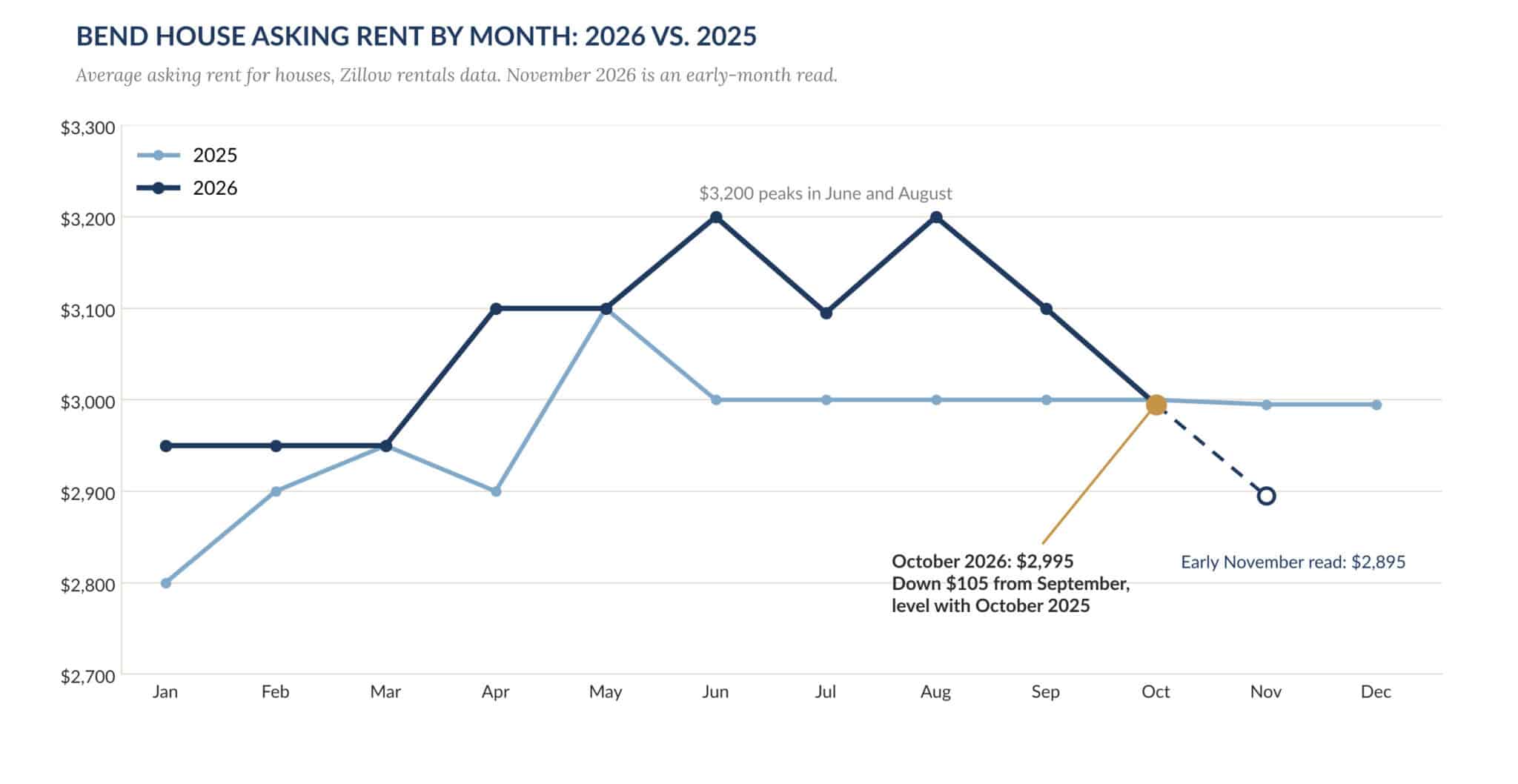
In our September Bend rental market report, we said rents were stepping down from their summer peak and that supply was building underneath. October delivered more of both. The average asking rent for a house in Bend was $2,995, down $105 (3.4%) from September's $3,100 and essentially flat against October 2025, when Bend sat at $3,000.
That second number is the one to sit with. For most of the spring and summer, Bend houses asked $100 to $200 more than they did in the same months last year. In October, this year's line came all the way back down to meet last year's. Since the $3,200 high in August, the average has given back about $205, or 6.4%. Last fall looked different: rents held at $3,000 from June straight through October with barely a wobble.
If you check Zillow this week, you will see a lower number still: $2,895, down another $100 for the month and $80 (2.7%) below a year ago. That is Zillow's early November snapshot, so we treat it as a preview and not as October's result. If it holds, November will be the first month of 2026 in which Bend houses clearly ask less than they did a year earlier.
Rent Growth: The Steadier Number Is Cooling Too
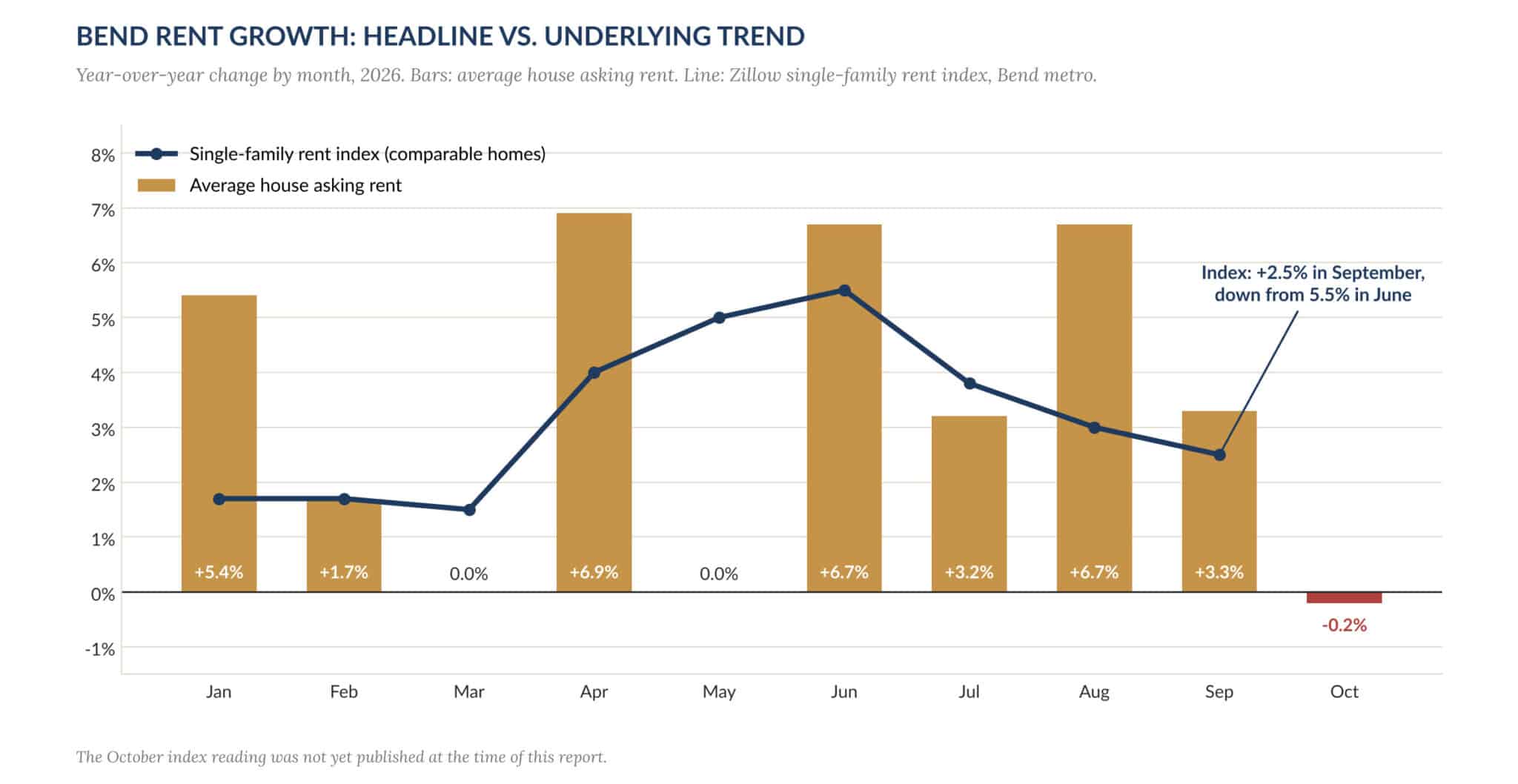
A falling average does not mean every Bend house is worth $105 less than it was a month ago. The average moves with the mix of homes on the market, and the mix shifted toward less expensive houses in October (more on that below). To see past that, we check Zillow's rent index for single-family homes across the Bend metro, which tracks rent changes on comparable homes instead of whatever happens to be listed.
That steadier measure shows single-family rents up 2.5% from a year ago as of September, the latest month available. That is down from 3.0% in August and a peak of 5.5% in June, and the index itself slipped about 0.8% from August to September. So the honest read is this: rents on comparable Bend houses are still a bit higher than last year, but the pace has been slowing for three straight months, and the gap between this year and last is closing.
Our working number for underlying Bend house rent growth is now 2% to 3% a year, down from the roughly 3% we reported last month. That is still growth. It is just not a market where a landlord can count on a rising tide to cover an ambitious asking price.
Days on Market and Listings: The Most Supply We Have Tracked
As of November 1, there were 262 houses for rent in Bend, up 19 from the 243 we counted on October 5 and the highest count since we began tracking listing snapshots in late June. Current listings have been on the market an average of 57 days, up from 52 days a month ago and 44 days in early August.
Multiply those two numbers together and you get what we call inventory-days, a simple measure of how much unleased marketing time is sitting in the market. It rose 18% in under a month to 14,934, the largest jump we have recorded, and it is now up about 45% since late June. In plain terms, more houses are listed and each one is waiting longer for a tenant. Both halves of that equation moved the wrong way for landlords in October.
A fair caution: we started tracking these counts this summer, so we cannot yet tell you what a normal October looks like. Some of this build is the usual fall slowdown. What we can say is that total marketed supply has grown at every reading since late June, days on market have climbed at every reading since early August, and price has now started to respond.

How Many Bend Houses Are Sitting on the Market?
Bend has roughly 7,500 detached houses occupied by renters, based on U.S. Census survey data. With 262 listed, about 3.5% of Bend's single-family rental stock was on the market on November 1, up from 3.2% in early October and 2.3% at the end of June.
We call this listed availability, and it is the closest honest answer to "what share of Bend rental houses are on the market unrented." It is not a true vacancy rate. Some listed houses still have a tenant who has given notice, and some empty homes never get listed. What makes it useful is the direction, and the direction since June has been up. By any reasonable standard 3.5% is still a tight market. It is simply less tight than it was in June.
Where Houses Are Priced, and Who Can Afford Them
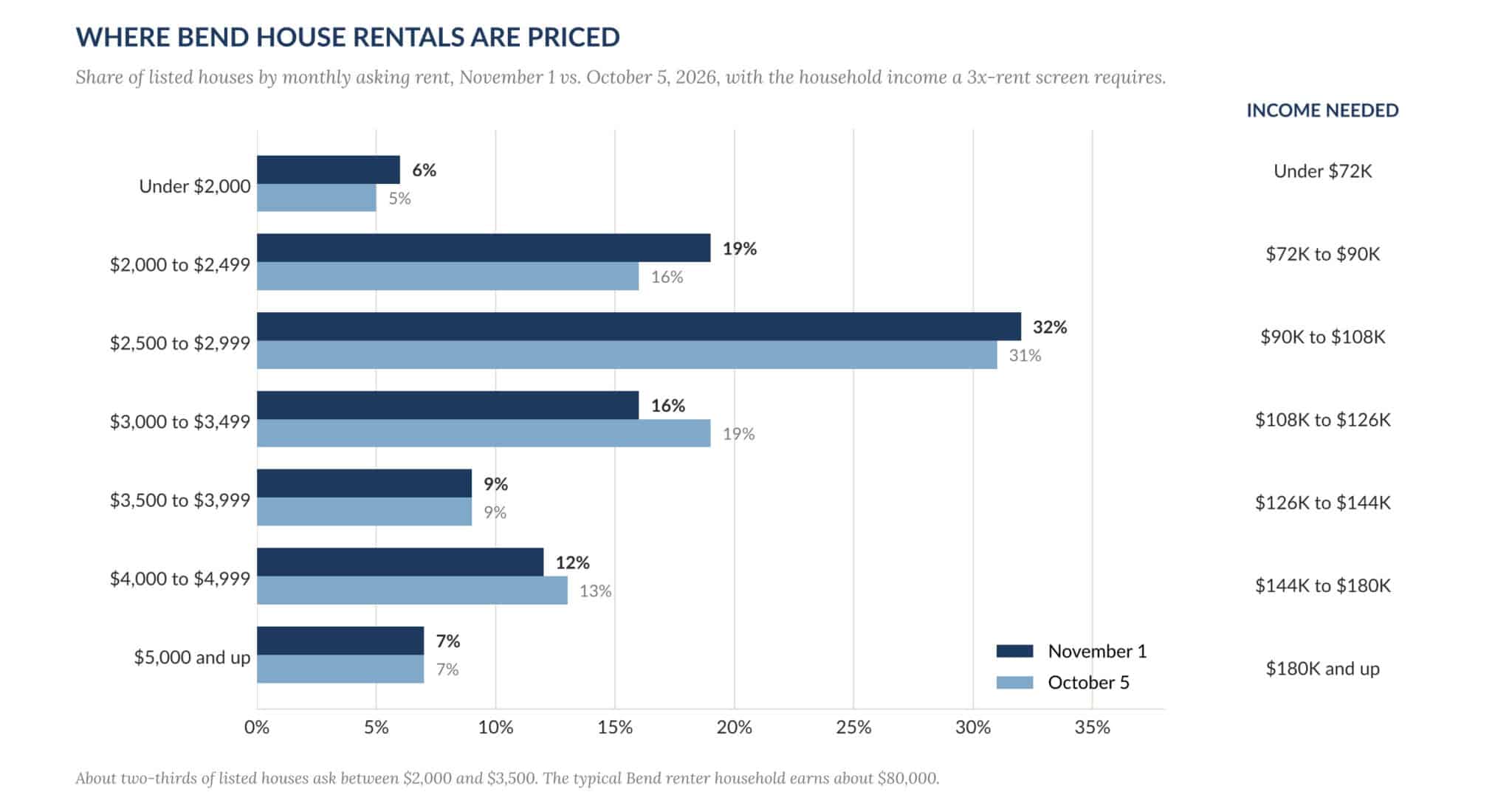
Bend's listed houses range from $850 to $15,000 a month, but about two-thirds ask between $2,000 and $3,500. Half ask less than about $2,900. The single busiest band is $2,500 to $2,999, which holds roughly a third of all listings.
Compare the two most recent snapshots and you can see why the average fell. The share of houses asking $2,000 to $2,499 grew from about 16% to 19%, while the $3,000 to $3,499 band shrank from 19% to 16%. Some of that is owners trimming prices to get leased before the holidays, and some is simply which homes happened to come up. Either way, the center of the market has moved down a notch, and a house listed at $3,200 today is competing against a lot more homes priced in the high $2,000s than it was in August.
Affordability sets the ceiling. A $2,995 house requires about $108,000 in household income under a standard three-times-rent screen. The typical Bend renter household earns about $80,000, according to the latest Census survey. The people who can comfortably qualify for an average house are a fraction of all renters, and every landlord with a vacancy this winter is courting the same group.
Bonus Metric: The Renewal Cushion Is Down to About $215
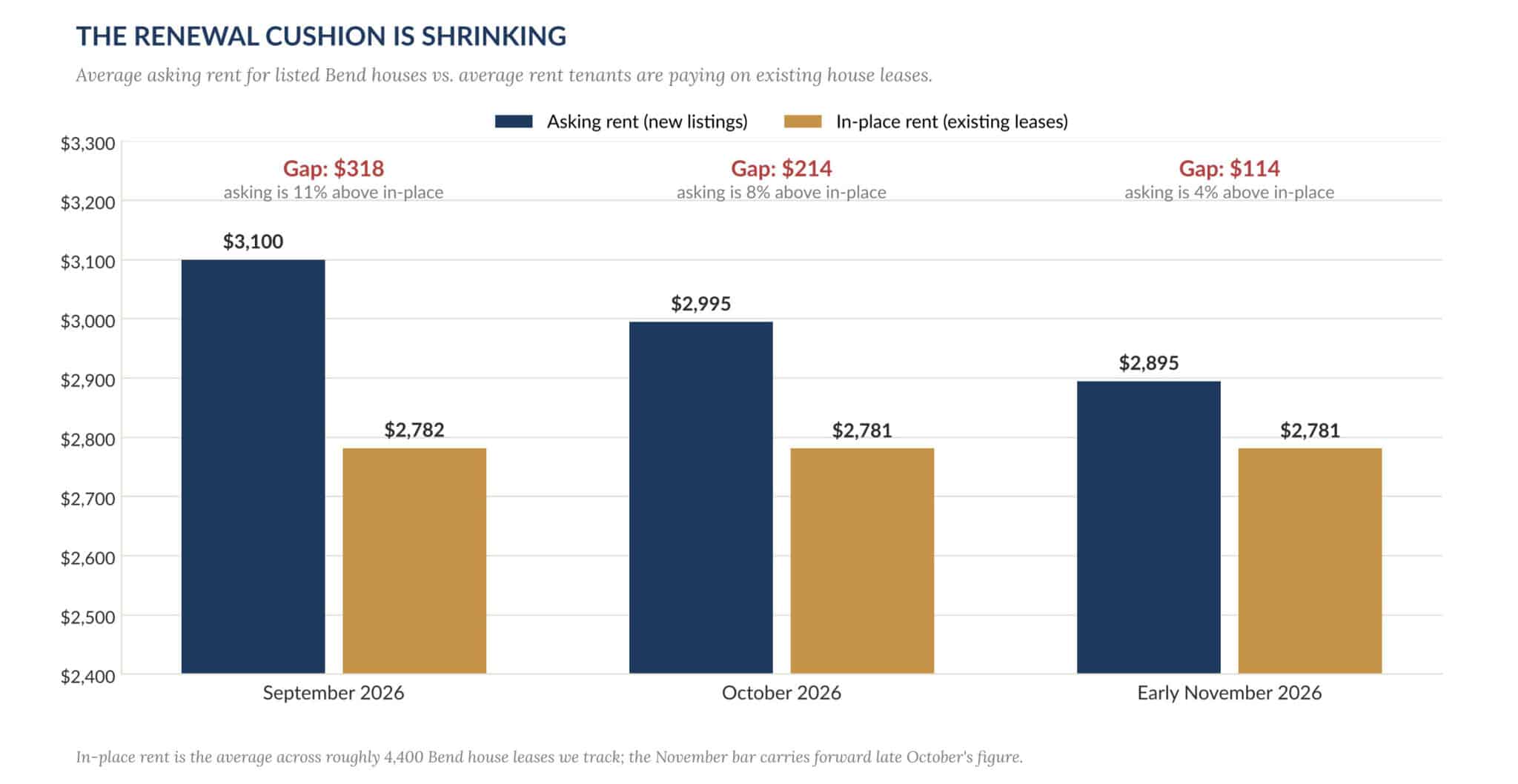
Each month we pick one number that explains the moment. This month it is the gap between what a newly listed house asks and what existing tenants actually pay. We think of it as the renewal cushion, because it tells you how much room there is to raise a sitting tenant's rent before you are charging more than the house would fetch on the open market.
Across the roughly 4,400 Bend house leases we track, tenants were paying an average of about $2,781 a month in late October, essentially unchanged from September. Against October's $2,995 asking average, that leaves a cushion of about $215, or roughly 8%. A month earlier it was a little over $300, and in August it was closer to $400. On Zillow's early November read, it is down to about $115.
Two things follow from that. First, the room for renewal increases has narrowed quickly. A tenant paying $2,800 who is offered a 3% increase lands at about $2,885, right at where the market is heading. Push much past that and you are asking a good tenant to pay more than the vacant house down the street. Second, turnover no longer pays for itself. Re-leasing the average house at today's asking rent would bring in roughly $215 more a month, or about $2,570 a year. One turnover at 57 days on market costs about $5,600 in lost rent before cleaning, paint, and leasing costs. That is more than two years of the extra rent, spent up front.
Tenancy Length: About Three Years, and Worth Protecting
How long do Bend tenants stay? Census survey data puts the typical Bend renter household at about three years in place, with nearly four in ten having lived in their home since before 2020. Across the Bend apartment communities we track, about 68% of tenants renew each year, which also works out to roughly three years.
House tenants tend to stay longer than apartment renters. Families settle into school zones, and moving a full household is a bigger project than leaving a one-bedroom. Our working estimate for Bend single-family tenancies remains three to four years. With the renewal cushion shrinking and vacancies taking close to two months to fill, every extra year a good tenant stays is worth more this winter than it was last summer.
Apartments: Softer Rents Now, Far Fewer on the Way
Apartments matter to house owners because they are where a tenant goes when a house feels out of reach. Bend's large apartment communities averaged $1,920 a month at the end of October, according to Yardi Matrix data published by RentCafe. That is down about $15 from a month earlier and slightly below where it stood a year ago. Among the apartment communities we track, occupancy has slipped into the low 90s as buildings approved in 2025 finish leasing up. A three-bedroom apartment averages about $2,278.
That puts the average house about $1,075 (56%) above the average apartment, and roughly $700 above a three-bedroom unit. When apartment managers are discounting to fill units, the lower end of the house market feels it first. If you own a smaller or older house priced under about $2,500, your real competition this winter includes a brand-new three-bedroom apartment with a move-in special.
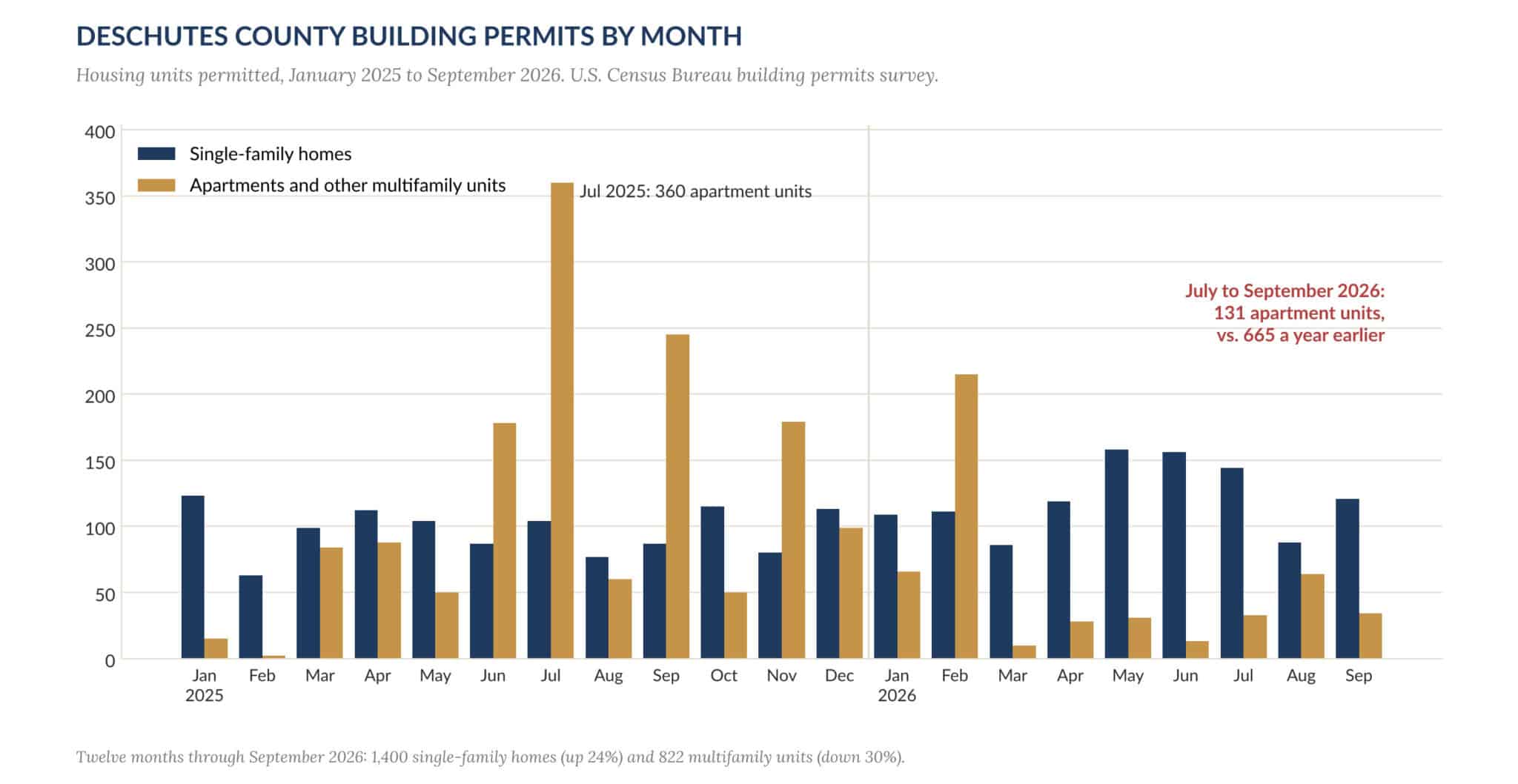
The longer view is more encouraging for house owners. Over the twelve months through September, Deschutes County permitted 1,400 single-family homes, up about 24% from the prior twelve months, and just 822 multifamily units, down about 30%. The last three months are starker: 131 apartment units permitted from July through September, against 665 in the same months of 2025. Monthly apartment permits are lumpy, and one large project can change the picture, but this is now seven straight slow months. The apartments approved last year will keep opening through 2027. After that, the pipeline gets thin, and fewer new apartments in 2028 means less competition for well-kept rental houses.
Buying vs. Renting: Rates Came Off the Peak, the Gap Stayed Wide
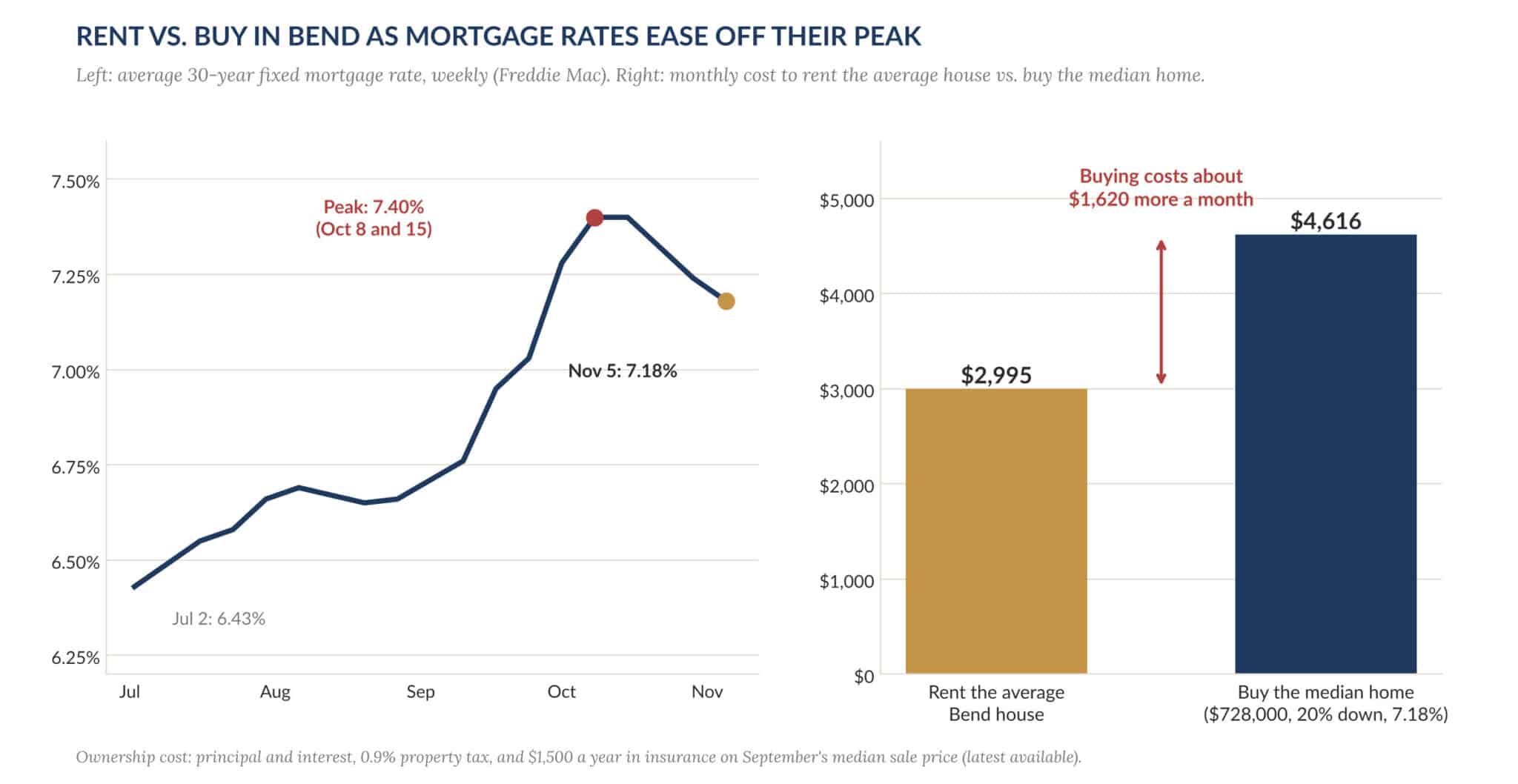
Last month's headline was mortgage rates. The average 30-year fixed rate peaked at 7.40% in mid-October, the highest since late 2023, and has eased for three straight weeks to 7.18% as of November 5, according to Freddie Mac's weekly survey. A year ago it was 6.22%.
For the home-sales side of the picture, the most recent local figures are still September's, unchanged from our last report: the median single-family home in Bend sold for $728,000, up 2% from a year earlier, with 155 closed sales (down 14%) and about three months of supply, according to local MLS data compiled in the Beacon Report. Going forward, we will report sales figures on a one-month lag so this report can reach you earlier in the month.
Run the math on that median home with 20% down, counting principal, interest, an estimated 0.9% property tax, and $1,500 a year in insurance, and owning costs about $4,616 a month at today's rate. Renting the average house costs $2,995. The difference, about $1,620 a month, is almost exactly where it stood a month ago. Rates eased a little, but so did rents, and the two moves cancelled out.
That gap is the quiet support under Bend's rental market. Households moving to Bend tend to earn more than the households leaving, but many arrive without the equity for a $145,000 down payment, so they rent a house instead of buying one. As long as buying costs half again as much as renting, those tenants stay in the rental pool. The flip side is worth watching: if rates fell back toward 6.25%, the monthly cost of owning would drop by roughly $360, and some of your best-qualified tenants would start shopping for a mortgage.
Rules of the Road: Notice Deadlines and the 10% Cap
Oregon's maximum allowable rent increase for 2027 is 10%, up from 9.5% this year, as KTVZ reported in September. With asking rents flat against last year, the cap is a legal ceiling and nothing more. The market, not the statute, is what limits renewals right now. Homes whose first certificate of occupancy is less than 15 years old remain exempt from the percentage cap, though the 90-day written notice rule applies to everyone.
Locally, there was no movement in October on Bend's proposed rental registry and registration fee. The fee amount, timeline, and exemptions are still unset. We will report back when a draft ordinance appears.
The Local Economy: A Strong Jobs Reading
Deschutes County unemployment fell to 3.9% in September, down from 4.5% in August and 4.7% a year earlier, and well below Oregon's 5.0%. Within Bend, unemployment was 3.6%, and the number of employed residents was up about 1.1% from a year ago. That is the best local jobs reading of the year. One month does not make a trend, and these early figures are often revised, so we will want to see October confirm it. Payroll jobs based in the metro were flat over the same twelve months, which tells us more residents are working without local employers adding many positions.
Bend's population is still growing about 1.5% a year, according to Portland State University estimates. Steady population growth, low unemployment, and expensive homeownership are the three legs holding up rental demand. None of them weakened in October.
Across Central Oregon: Three Headlines, One Story
We publish this report alongside our Redmond rental market report for October and our Sisters rental market report for October, and this month the three headline numbers pointed three different ways. Bend's average asking rent slipped 3.4%. Redmond's jumped more than 10% to $2,650, then fell back to $2,495 on the early November read. Sisters' spiked to $3,900 on a handful of high-end listings and then settled at $2,765. None of those swings describes what happened to the rent on any one house. In all three markets, the average moved mostly because the mix of homes on the market changed. Put all three on the same November 1 footing and the picture is calmer: Bend asks 2.7% less than a year ago, Sisters 1.3% less, and Redmond 4.0% more.
Look past the averages and the three markets agree. Rents on comparable homes are running about 2.5% above a year ago in both Bend and Redmond. What existing tenants pay barely moved in either city. Apartments are softening in both, with occupancy in the low 90s and move-in specials on offer. And at a 7.18% mortgage rate, buying costs more than renting in every one of them.
Where they differ is supply, and that is where Bend stands out. Bend's total marketed supply grew 18% in under a month. Sisters' grew about 15%, on just 17 listings that have averaged 85 days on the market. Redmond's was essentially flat, with 45 houses listed. Bend houses still lease the fastest, but the lead has shrunk: current listings average 57 days on market in Bend against 60 in Redmond, a gap of 3 days that was 9 days a month ago. Bend also has the thinnest renewal cushion of the three, about $215 against roughly $250 or more in Redmond and Sisters. On the other hand, Bend tenants are among the least likely to leave for a mortgage. The monthly cost of owning over renting is about $1,620 in Bend and $1,740 in Sisters, but only about $550 in Redmond, so Redmond is where falling rates would pull tenants into buying first.
| Market | Average asking rent, October | Early November read | Houses listed (Nov 1) | Average days on market | Cost to own minus rent |
|---|---|---|---|---|---|
| Bend | $2,995 | $2,895 | 262 | 57 | About $1,620 a month |
| Redmond | $2,650 | $2,495 | 45 | 60 | About $550 a month |
| Sisters | $3,900 (skewed by a few high-end listings) | $2,765 | 17 | 85 | About $1,740 a month |

Why This Matters for Small Investors and Landlords
Put the pieces together and October tells a clear story. Tenants are plentiful and employed. Buying a home costs far more than renting one. Very few new apartments are in the pipeline. None of that says "weak market." What has changed is the price. Asking rents have dropped back to last year's level, more houses are competing for the same tenants, and those houses are taking longer to lease. Demand is fine. Pricing power is what softened.
That distinction matters because it changes what you should do. In a weak-demand market, you cut costs and wait. In a market like this one, you compete on price and on retention. The owners who struggle this winter will be the ones who list at a summer number, sit for two months, and then take the lower rent anyway, minus two months of income.
What it means for you: Your most valuable asset this winter is a good tenant who is already in the house. Offer renewals early and keep increases modest. If you do have a vacancy, price it against what is listed today, not what your neighbor got in August. The long-term case for owning a well-located Bend house is intact. The short-term job is staying occupied.
For investors weighing a purchase, underwrite rents at $2,900 to $3,000, not the summer peak, and stress-test your financing at 7% or higher. At today's prices and rates, the rent on a median Bend house does not cover the cost of a new mortgage, so the deals that work are cash-heavy or have a clear plan to add value. For owners who already hold a low-rate loan, the math points the other way: this is a market to hold, keep the house full, and let the thin apartment pipeline work in your favor over the next few years.
| Move | What to do | Why it works this month |
|---|---|---|
| Renew before you re-list | Offer good tenants a renewal now with an increase in the 2% to 3% range, or hold rent flat for a tenant you especially want to keep. | The gap between asking and in-place rent is down to about $215. A turnover costs about $5,600 in lost rent before make-ready. |
| Price vacancies to today's listings | Check what comparable houses are asking this week. A third of Bend listings sit between $2,500 and $2,999. Adjust after two weeks without solid showings. | Listings are at a high, days on market reached 57, and the average is still drifting down in early November. |
| Get notices out on time | An increase taking effect March 1 needs written notice by December 1 under Oregon's 90-day rule, or by November 28 if you send it by mail. | Early notice gives tenants time to say yes before they start browsing 262 other houses. |
| Fix your lease calendar | When you sign or renew this winter, choose a term that ends between April and August. | Houses that come vacant in spring and summer lease faster and for more than houses that come vacant in November. |
| Underwrite conservatively, hold patiently | Model purchases at $2,900 to $3,000 rent and a 7% plus rate. If you already own with a low-rate loan, hold. | Owning costs about $1,620 a month more than renting, and apartment permits are down 30%, which supports house rents once 2025's projects fill. |
Bend's rental market still rewards landlords who price to the data and take care of good tenants, and that matters most in the slow months. At Legacy Property Management, we help investors across Central Oregon do exactly that, from pricing and screening to renewals that keep homes occupied. Reach out today to talk through your Bend rental property, browse our Bend rental market report archive, or compare this month with our Redmond and Sisters October reports.


Sisters Rental Market: October 2026
November 10, 2026 Sisters Rental Market: October 2026 Home Sisters Oregon Rental Market Report · October 2026 Monthly market report from Legacy Property Management The

Redmond Rental Market: October 2026
November 10, 2026 Redmond Rental Market: October 2026 Home Redmond Rental Market October 2026: Rents Jump to $2,650 Redmond Oregon Rental Market Report · October
Sisters Rental Market: September 2026
October 14, 2026 Sisters Rental Market: September 2026 Home Sisters Oregon Rental Market Report · September 2026 Monthly market report from Legacy Property Management The

OWNERS & PROPERTY MANAGERS
Steven Kaufman and Kolby Knickerbocker
info@legacypropertymanagement.com
(541) 508 5815