Sisters has always been the small mountain town that punches above its weight. A walkable downtown, a postcard backdrop, and a steady pull on remote workers and second-home buyers have kept its rental market interesting far out of proportion to its roughly 3,000 residents. This month, the single-family side of that market is sending a more cautious signal than we have seen in a while, and it is worth unpacking carefully rather than reading too much into any one number.
The short version: single-family asking rents eased in May, listings are taking longer to move, and a wave of new construction is landing in a town that does not take much new supply to feel crowded. None of that is cause for alarm, but it does change the playbook for the months ahead.
Rents: A Step Back, Not a Slide
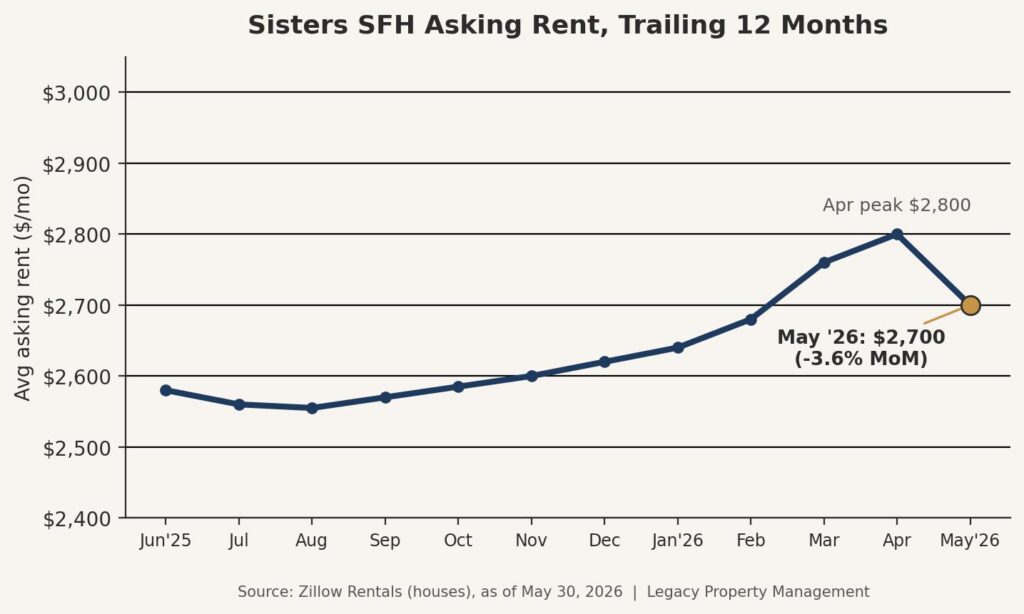
The headline number from Zillow is an average asking rent of $2,700 for single-family houses in Sisters as of late May. That is down $100, or 3.6%, from April, and up $100, or 3.8%, from a year ago. Keep in mind this is an asking figure drawn from a small pool of active listings, so it reflects what landlords are hoping to get on units available right now, not necessarily what tenants across town are actually paying.
That distinction matters here more than usual. Our own database puts the in-place rent, what tenants are actually handing over each month, at roughly $2,386 across a sample of occupied single-family homes. That is about $314, or 13%, below the Zillow asking figure. A gap like that usually means one of a few things: the handful of homes currently listed skew toward the higher end, landlords are testing ambitious prices on new listings, or recent softening simply has not worked its way into existing leases yet. Most likely it is a bit of all three.
The month-over-month dip is the part that catches the eye. May usually marks the start of the strong leasing season, when families time moves around the school calendar and demand firms up. A 3.6% decline against that seasonal tailwind is a genuine signal worth respecting. At the same time, the market is still running about 3.8% ahead of where it was last May, so this reads as a market catching its breath rather than reversing course
.
 .
.For context, Oregon’s 2026 rent stabilization cap sits at 9.5% for units 15 years or older, down from 10.0% in 2025. Sisters’ year-over-year growth is comfortably inside that ceiling, which means the market itself, not the regulatory limit, is setting the pace here.
How Long Listings Are Sitting
If one number defines the mood this month, it is days on market. Active single-family listings in Sisters are averaging 134 days before they lease, according to current Zillow data. That is a long time by any standard. In a balanced market, a well-priced single-family rental typically moves in 30 to 45 days.
There is a more encouraging counterpoint buried in our own records: homes that actually signed leases in the past 30 days did so in about 62 days. So the picture is really two stories layered on top of each other. The homes that are priced right are leasing, if not quickly then at least within a couple of months. The homes sitting at 134 days are, in most cases, the ones priced ahead of what this market will currently bear.
It’s worth noting here that because Sisters is such a small market, a few homes that are overpriced and thus sitting on the market, can sway the dataset heavily. A large DOM like 134 tells me that, rather than Sisters being an undesirable rental market, there are one or two homes that are grossly overpriced and bringing the DOM up significantly.
[.
 [.
[.A Word on Vacancy
This is the metric where we want to be the most careful. Our database shows 28 unleased single-family units against 157 occupied ones, which mechanically works out to a 15.1% vacancy rate. Taken at face value, that would be a striking jump from the roughly 10.7% we reported for Sisters earlier this year, and it would point to real oversupply.
We are not ready to hang the whole narrative on that figure, and here is why. Sisters is a small market, and small samples swing hard. Only seven of those units actually show up as active Zillow listings, which suggests many of the 28 may be off-market for ordinary reasons: between tenants, mid-renovation, in management transition, or pulled toward seasonal vacation use rather than long-term rental. A genuine 15% long-term vacancy rate and only seven marketed listings do not easily coexist. The honest read is that vacancy has likely loosened from the tight conditions of last year, but the precise 15.1% should be treated as a noisy ceiling rather than a clean measurement. We will watch whether it holds as the sample grows.
The Number Driving This Month: A Supply Wave
Every month has one metric that explains the rest, and in May it is new construction. Deschutes County permit records show 48 new rental units permitted in Sisters over the trailing 12 months: 43 multifamily and 5 single-family. Against an existing single-family rental base of roughly 185 units, that 48-unit wave equals about 26% of the existing inventory.
.
 .
.For a town this size, that is a lot of housing arriving in a short window. A market cannot absorb a quarter of its rental base in new supply without some softening in rents and a longer runway to fill units, and that is very likely a big part of what the days-on-market and rent numbers are reflecting right now. The encouraging part is that almost all of this new supply is multifamily, and as you will see below, it is leasing well. The single-family pipeline itself is barely growing.
What Multifamily Is Adding to the Story
Single-family is the focus here, but the apartment side of Sisters is doing something interesting that directly shapes the single-family outlook.
Multifamily occupancy reached 96.2% in May, up nearly two points on the month and up dramatically from around 65% a year ago, when much of this new product was still leasing up. Those apartments are filling, and they are filling fast: multifamily units are averaging just 36 days to lease, roughly a quarter of the time single-family listings are taking. In-place multifamily rents sit near $1,788, essentially flat month over month and up about 2.6% on the year. Asking rents actually dipped below in-place rents, a sign some operators are offering modest concessions to compete for the last tenants.
 .
.Put those two segments next to each other and the dynamic becomes clear. At roughly $1,788, an apartment in Sisters undercuts the typical single-family asking rent by a wide margin. In a town where affordability is increasingly the deciding factor, that price advantage is steering cost-conscious renters toward the apartments that are now plentiful and move-in ready. Single-family homes still own the things apartments cannot offer, the yard, the garage, the privacy, room for pets and kids, but this month the budget conversation is winning more often than the lifestyle one.
What This Means If You Own a Single-Family Rental in Sisters
The practical takeaways are straightforward. Price to today’s market, not to last spring’s. A 134-day average on active listings is the market’s way of saying that aspirational pricing gets punished with vacancy, and an empty home at a high asking rent earns far less than an occupied one priced a touch below. If your unit has been sitting, a modest adjustment will almost always beat another month of carrying costs.
Lean hard into retention. With new supply landing and rents softening, the cheapest tenant you will find this year is the good one you already have. Renewing a strong tenant at a fair number, even a flat one, avoids turnover costs and weeks of vacancy in a market that is taking its time to fill units.
Compete on what apartments cannot match. The single-family premium over multifamily is real, but it has to be justified. Emphasize the yard, the parking, the pet-friendliness, and the space that a $1,788 apartment simply does not provide.
Underwrite new purchases conservatively. If you are weighing an acquisition, build your model on in-place rents closer to $2,386 than on the $2,700 asking figure, assume a longer lease-up, and stress-test for the supply still working through the system.
For a fuller picture of how Sisters fits into the broader region, our Central Oregon market coverage tracks Bend and Redmond alongside it, and the Census Bureau’s housing data offers useful national context on where vacancy and rents are heading.
The Outlook
Near term, expect the single-family segment to stay soft as the new multifamily supply finishes absorbing and the season’s listings work through a more patient pool of renters. Rents are more likely to stabilize or drift modestly than to climb over the next few months. Looking further out, Sisters has a habit of tightening quickly once a supply wave clears, because so little new single-family product is being built. If the current 48 units lease up and the pipeline stays thin, the market could rebalance by spring 2027. The risks to watch are additional permitting and any cooling in the wider Bend-area economy; the opportunity is that this town’s underlying appeal rarely stays quiet for long.
Navigating a shifting market like this takes local expertise and a steady hand on pricing, marketing, and tenant retention. At Legacy Property Management, we work with single-family and small multifamily owners across Sisters and Central Oregon to keep good tenants in place and vacancy down. Reach out today to talk through what your Sisters rental should be doing in this market.



Redmond Rental Market: August 2026
September 10, 2026 Redmond Rental Market: August 2026 Home Central Oregon Rental Market Report · August 2026 Monthly market report from Legacy Property Management The

Sisters Rental Market: August 2026
September 10, 2026 Sisters Rental Market: August 2026 Home Central Oregon Rental Market Report · August 2026 Monthly market report from Legacy Property Management The

Bend Rental Market: August 2026
September 10, 2026 Bend Rental Market: August 2026 Home Central Oregon Rental Market Report · August 2026 Monthly market report from Legacy Property Management The