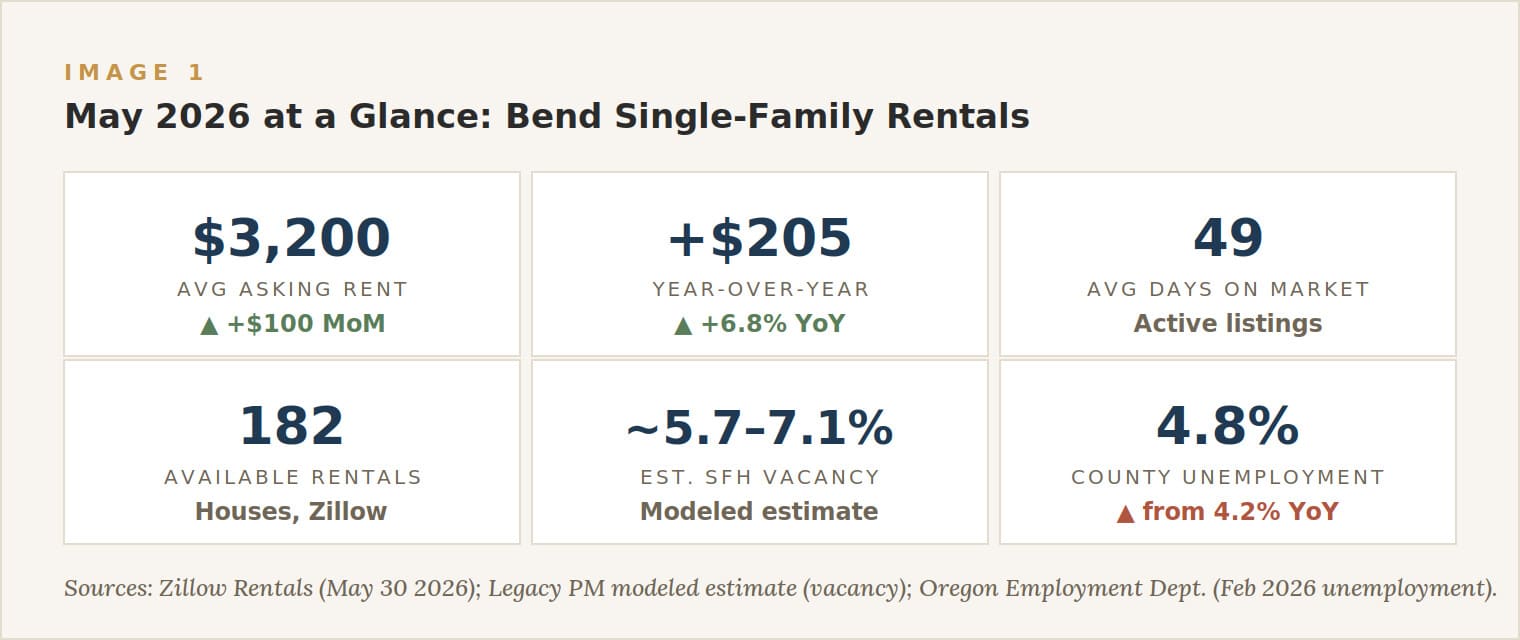
Bend’s single-family rental market keeps doing the thing it has done all year: quietly outrunning the apartment market and shrugging off the cooling that has settled over so much of Oregon. As of the end of May 2026, the average asking rent for a house in Bend reached $3,200 per month, according to Zillow rental data. That is up $100 from the previous month and $205 from a year ago, a steady, unflashy climb that tells you almost everything about where leverage sits in this market right now.
But asking rent is only half the story, and the more important half is what is happening beneath the surface: a construction slowdown that is reshaping the next two years of supply. Let us walk through the numbers the way we always do, leading with what we know, flagging what we are estimating, and being honest about the gaps.
The Headline Number, and the One Beneath It
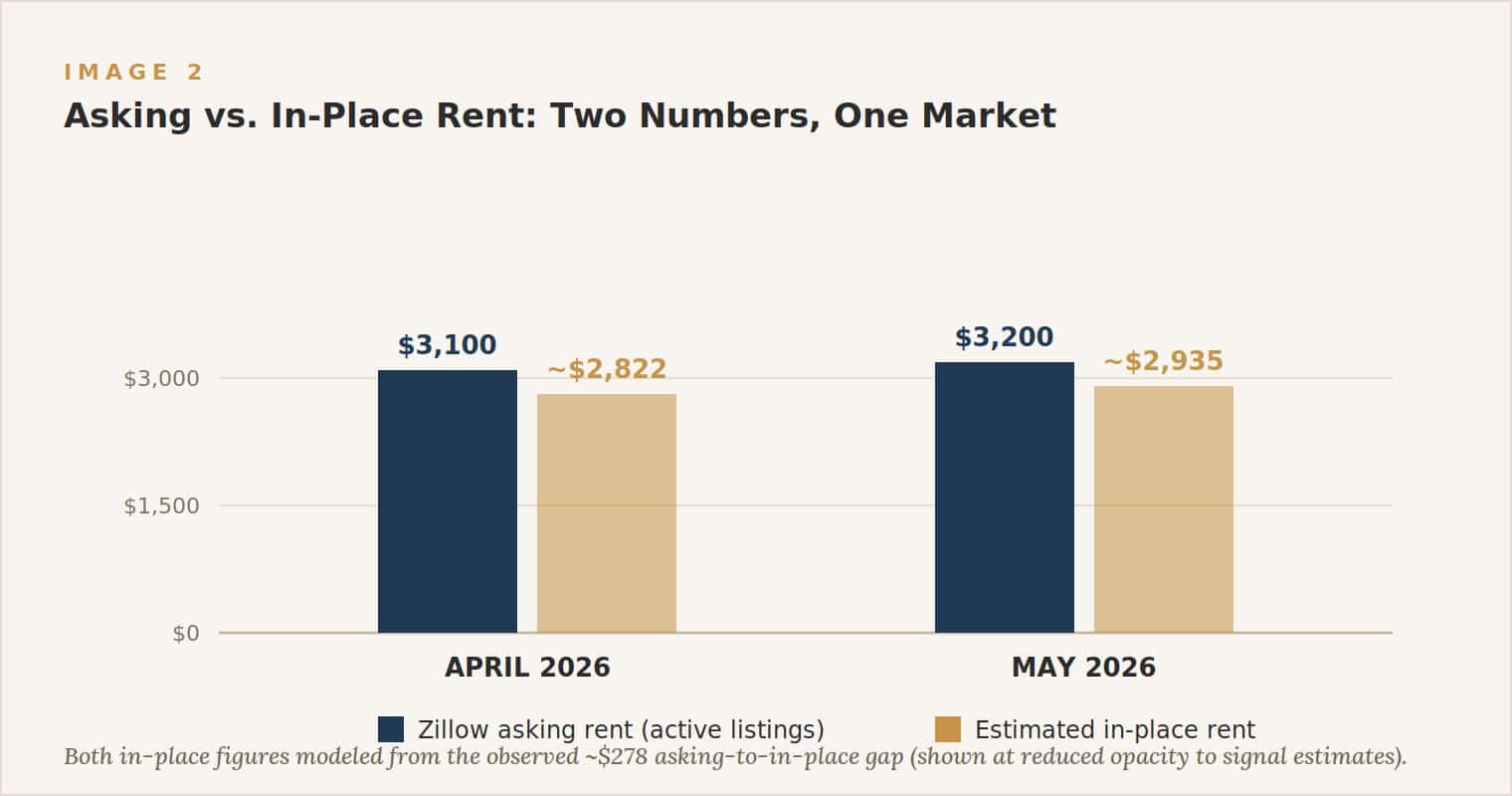
When Zillow reports a $3,200 average for Bend houses, that figure reflects asking rent on active listings, the price landlords are advertising on units sitting on the market today. It is a real and useful number, but it is not the same as what tenants are actually paying across all existing leases. In our Q1 reporting we measured that gap directly: Zillow’s March asking figure of $3,100 sat about $278 above the in-place average of roughly $2,822 drawn from active lease data. Asking rent captures the leading edge of the market; in-place rent captures the lived reality across the whole rental stock.
Applying that same methodology to May, a $3,200 asking figure points to an estimated in-place average in the neighborhood of $2,920 to $2,950. The two numbers tell complementary stories. Asking rent shows you momentum, the price a landlord can command on a fresh listing today. In-place rent shows you the income base across the portfolio, dampened by Oregon’s rent-cap on renewals and by leases signed in softer months. For an investor underwriting a purchase, the in-place figure is the conservative anchor. For a landlord pricing a turnover unit this summer, the asking figure is the live signal.
Rent Growth: Steady Climb, Not a Spike
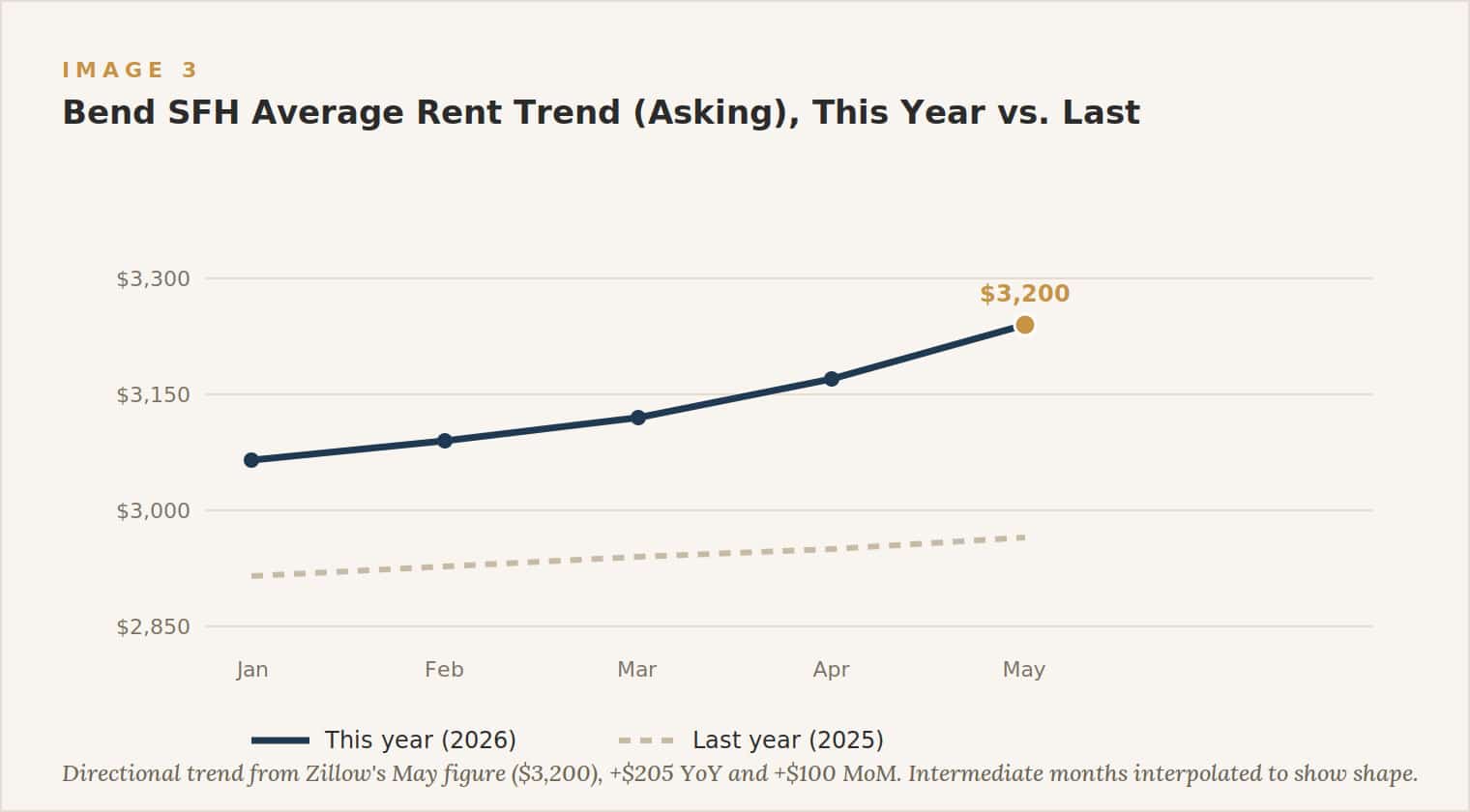
The month-over-month move is the metric worth watching here, because it shows the market still has momentum heading into peak leasing season. A $100 jump from April to May is roughly a 3.2% monthly gain on the asking side, the kind of step you see when relocation season kicks in and inventory tightens against early-summer demand. The year-over-year picture is calmer: +$205, or about 6.8%, which lands comfortably under Oregon’s rent stabilization ceiling and signals healthy, sustainable growth rather than the double-digit spikes of the pandemic years.
Context matters. Back in Q1, SFH rents were running up roughly 8.8% year-over-year. The fact that the annual pace has eased toward the high-6% range while monthly momentum stays positive suggests the market is normalizing, not stalling. Houses are still the strongest corner of Bend’s rental market, but the trajectory is flattening into something more durable.
Days on Market and the Pace of Leasing
Zillow pegs the average time on market for Bend houses at 49 days, with 182 active rental listings in the houses category as of late May. That is a workable, mid-cycle pace, not the frantic sub-two-week turnover of 2021, but nowhere near the stalled inventory that signals real trouble. It tells you that well-priced houses in good condition are moving, while overpriced or poorly presented listings are the ones that sit.
A quick word of caution on this metric, consistent with how we have always handled it: there is no authoritative public source tracking single-family rental days on market at neighborhood granularity. Zillow’s 49-day figure is the best market-wide signal available, and it squares with what we see on the ground. We treat it as directional rather than precise, and we are skeptical of any report claiming hyper-specific neighborhood-level rental DOM figures, because the data simply is not collected that way.
Vacancy: Still an Estimate, Still Healthy
This is the metric where Bend’s SFH market remains genuinely hard to measure, and we would rather tell you that plainly than invent false precision. Unlike apartments, where management databases track occupancy across large portfolios, single-family rentals are scattered across thousands of individual owners. There is no published SFH vacancy rate for Bend.
What we can do is triangulate. Using U.S. Census Bureau figures (roughly 16,337 renter-occupied units citywide), backing out the multifamily stock, and layering in our database’s unleased-unit count, we arrived in Q1 at an estimated SFH vacancy range of 5.7% to 7.1%. Nothing in the May data moves that materially. It is a meaningful step up from the sub-2% tightness Bend saw during the pandemic, but it remains notably healthier than the multifamily side, where vacancy has run around 12% on the elevated end. For SFH landlords, that gap is the whole point: houses are absorbing demand that apartments cannot hold onto.
Tenancy: Where Houses Quietly Win
We do not have SFH-specific retention data for Bend, so we lean on the multifamily benchmark as a labeled proxy and adjust for what national patterns tell us. Bend-area multifamily retention runs around 60.5%, with average tenancy near 2.5 years. Single-family tenants almost universally stay longer, typically 3 to 5 years, because the households renting houses (families, established professionals, would-be buyers waiting out high mortgage rates) face higher moving costs and value stability.
That longer tenancy is one of the most underrated advantages in the SFH model. Every avoided turnover saves a landlord somewhere in the range of $1,000 to $3,000 in make-ready costs, lost rent, and re-leasing expense. A house that holds a tenant for four years instead of cycling every two is materially more profitable, even at an identical headline rent. It is the quiet math that makes single-family rentals so resilient through softer cycles.
This Month’s Driver: The Construction Slowdown
If there is one number reshaping the next two years of this market, it is not a rent figure, it is a permit figure.
Federal building-permit data for the Bend metro shows the monthly pace cooling through late 2025 and into early 2026, with January 2026 registering just 215 new private housing units authorized, down from the 400-plus monthly readings seen as recently as last September. The wave of apartments that drove multifamily vacancy up to roughly 12% is now largely delivered, and very little new supply is entering the pipeline behind it.
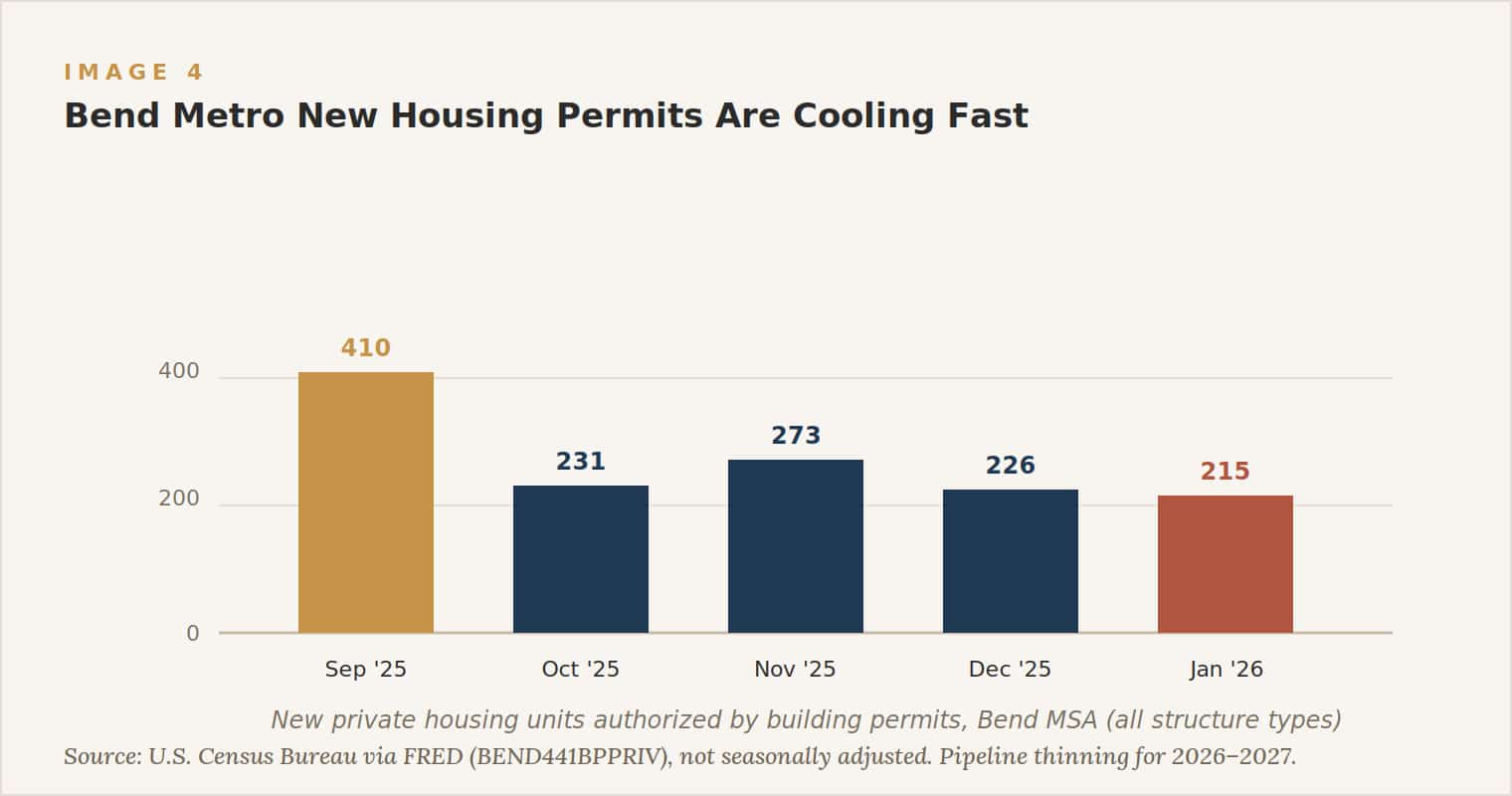
Here is why this matters for anyone holding or buying a single-family rental in Bend. New supply is the single biggest threat to rent growth, and that threat is receding. The projects that penciled out at 4% construction debt in 2021 do not work at today’s 6.5% to 7%-plus rates, so fewer shovels are hitting the ground. The apartments already built are being absorbed, and the thin pipeline behind them sets the stage for the market to tighten again around 2027 to 2028. Landlords who price competitively and keep good tenants in place through the current cycle are positioning themselves for a stronger market on the other side of it.
The Multifamily Backdrop (and Why SFH Still Leads)
Single-family is the story, but the apartment market is the weather around it. Multifamily vacancy in Bend climbed above 10% during the construction wave and has sat well above its long-run average, with some operators offering concessions like free weeks of rent to fill units. That softness on the apartment side is exactly what makes the SFH strength so notable: houses have held their pricing power while apartments have had to discount.
The encouraging signal for the whole market is that multifamily vacancy now appears set to decline as the supply wave clears and the construction pipeline thins. If apartments tighten, the upward pressure on rents flows through the entire rental ecosystem, houses included. For now, the premium that single-family commands over apartments remains wide, and the fundamentals say it should stay that way through the rest of 2026.
The Employment Picture
No rental market floats free of its job market, so it is worth noting that Deschutes County’s seasonally adjusted unemployment rate sat at 4.8% in February 2026, up from 4.2% a year earlier and the highest level since 2016 outside the pandemic. The county has shed jobs modestly over the past year, with public-sector losses outpacing private-sector gains. This is not alarm-bell territory, Bend’s economy remains fundamentally sound, but it is a reason for landlords to underwrite conservatively, screen tenants carefully, and resist the temptation to over-reach on asking rents in a market where affordability is doing real work.
Regulatory Note: Oregon Rent Stabilization
Oregon remains the only state with statewide rent stabilization. For 2026, annual rent increases on existing tenancies are capped at 10% maximum (the formula is 7% plus regional CPI, with a hard ceiling). This cap applies to renewals, not to new leases on turnover, which is part of why asking rents can run ahead of in-place rents. Always confirm the current year’s cap with the Oregon Department of Administrative Services before issuing increase notices.
What This Means for Bend Landlords and Investors
The May data paints a coherent picture. Single-family rents are climbing steadily, not spiking. Houses are leasing at a healthy pace and holding tenants longer than apartments do. Vacancy on the SFH side is comfortable. And underneath it all, a construction slowdown is quietly setting up tighter conditions a couple of years out. For an investor, the takeaway is that Bend’s single-family rental fundamentals remain among the strongest in Central Oregon, and the supply trend is a tailwind, not a headwind, for anyone with a multi-year horizon.
The watch items are affordability and employment. With asking rents at $3,200 and unemployment ticking up, the ceiling on rent growth is increasingly set by what local households can actually pay. The landlords who win in this environment are the ones who price to the in-place reality, invest in retention, and let the thinning supply pipeline do the heavy lifting over the next 18 to 24 months.
Navigating a market like this takes local expertise and a steady read on the numbers. At Legacy Property Management, we partner with investors and owners across Bend and Central Oregon to price competitively, protect their properties, and maximize long-term returns. Reach out anytime if you would like us to dig into the numbers on your specific property.
Prepared by Legacy Property Management, Bend, Oregon. Asking-rent, days-on-market, and listing figures from Zillow Rentals (May 30, 2026). Vacancy and tenancy figures are modeled estimates and labeled multifamily proxies carried forward from our Q1 2026 analysis, with the data trail visible. Permit data from the U.S. Census Bureau via FRED; unemployment from the Oregon Employment Department; supply context from the Oregon Journalism Project. We believe transparent reporting, including acknowledging what we do not know, builds more trust than filling gaps with false precision.



Redmond Rental Market: August 2026
September 10, 2026 Redmond Rental Market: August 2026 Home Central Oregon Rental Market Report · August 2026 Monthly market report from Legacy Property Management The

Sisters Rental Market: August 2026
September 10, 2026 Sisters Rental Market: August 2026 Home Central Oregon Rental Market Report · August 2026 Monthly market report from Legacy Property Management The

Bend Rental Market: August 2026
September 10, 2026 Bend Rental Market: August 2026 Home Central Oregon Rental Market Report · August 2026 Monthly market report from Legacy Property Management The